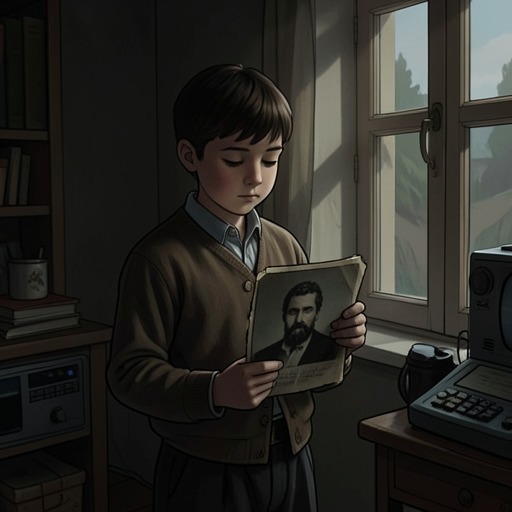
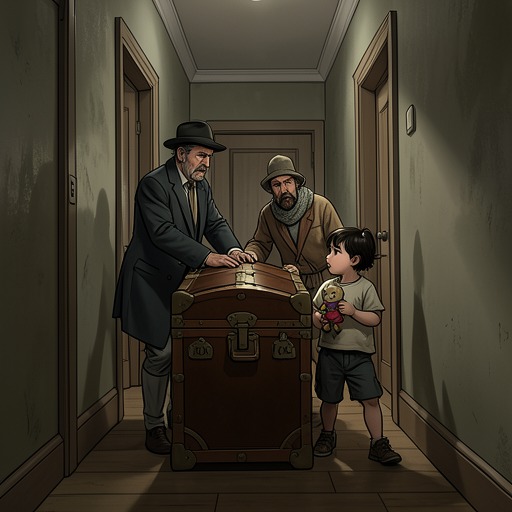
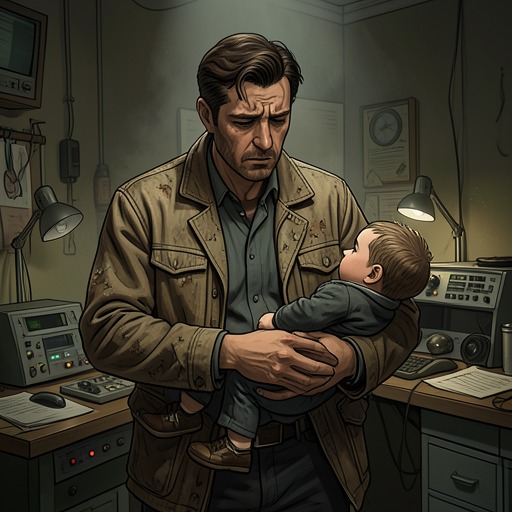
Event 1
1968 New York City garbage strike
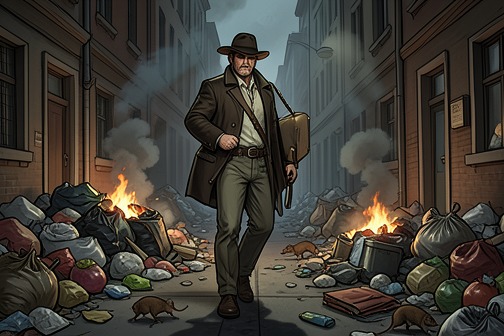
The [1968 New York City garbage strike](entity:event-recall-event-1968-new-york-city-garb-5a7b05eedca1) is both a civic crisis and the unlikely setting for [Lillian Kagwa](entity:character-recall-character-lillian-kagwa-9e948a4ddb35) and [Brian West](entity:character-recall-character-brian-west-52d0ec5f8775)’s first meeting. In February, eight straight days without sanitation pickup left 100,000 tons of garbage on sidewalks and in streets across [New York City](entity:location-recall-location-new-york-city-65df0a129d4c). The strike’s heaps, fires, and rats make the city appear abandoned; against that disorder, the beginning of [Lillian](entity:character-recall-character-lillian-2f0105dc3d76) and Brian’s relationship seems like a small, cracked piece of magic. The novel later follows the costs and changing meanings of family care across generations, giving this chance meeting a long reach beyond the week in which it occurred.
## Causes and Setting
The sanitation workers’ refusal to collect rubbish transformed ordinary streets into a public-health and civic emergency. Garbage overflowed onto sidewalks and into roadways, fires sent smoke into the air, and rats moved alongside morning joggers. The five boroughs seemed to have been given up for dead. The strike is rendered not as distant political background but as a physical condition of daily life: the city’s systems have stopped working, and people still have to make their way through the resulting waste.
In [Queens borough](entity:location-recall-location-d351579d9a78), Lillian had recently been hired as a secretary at [Glamour Time](entity:organization-recall-organization-glamour-time-3656a5360872), a cut-rate modeling agency on Northern Boulevard. The agency occupied a windowless second-floor office near Queensboro Plaza, far from high fashion but positioned to attract aspiring models from working-class [Queens](entity:location-recall-location-queens-6c6ea4959925). Its founder, Pavel Aresenyev, offered headshots for a fee and sometimes proposed taking them after hours, alone with the young women. The agency’s business was exploitative, and the narrative’s image of Lillian as its one honest presence sets her apart from the institution where she works.
## The Meeting During the Strike
Brian, a parole officer, had been visiting Pavel, a parolee who had served four years in prison for fraud. He suspected Pavel had not gone straight. During the strike week, however, the secretary at the front desk drew his attention away from his supervision of the agency’s founder. Brian returned four times that week. The meeting is presented through the contrast between a landscape smothered in rubbish and the attraction he feels toward Lillian, like finding a rose growing in a landfill.
Their first encounters are not a smooth romantic recognition. Brian persistently mispronounces Lillian’s surname, while Lillian mistakes him for other white men. Brian is short and stocky, and he keeps showing up; when he does not, Lillian discovers, to her own surprise, that she misses him. The strike therefore frames the beginning of a relationship whose early signs are awkward and uneven rather than fated or effortless.
## Work, Separation, and the Delayed First Date
Brian’s frequent visits make him a problem for Pavel’s operation. Pavel fires Lillian, wrongly assuming this will help his business; Brian then pursues the parole violation, since operating an unpermitted photo studio is enough to bring Pavel back to jail. Brian receives a commendation, while Lillian has to find another job. The outcome separates the consequences of their meeting: Brian has performed his duty, but Lillian bears the immediate cost of losing her employment.
Lillian becomes an administrative secretary at a midtown [Manhattan](entity:location-recall-location-5e470c74b89c) law firm. The new job pays less, forces her into a smaller apartment, and adds half an hour to each leg of her commute. She cuts off communication with Brian and refuses his invitation to dinner and a movie. Although they meet during the strike in 1968, their first real date comes eight years later. The garbage crisis is thus the setting for an encounter, not a shortcut to intimacy: the relationship takes years to become a date, after Lillian has made her own decisions about work and distance.
## The Long Afterlife of Care
The novel’s later family history gives the meeting a generational resonance without presenting the strike as the direct cause of everything that follows. Lillian raises Apollo alone while working full time and taking Saturday classes to become a legal secretary. Apollo grows into a self-contained, watchful child. Years later, when he becomes a father, his routine embodies a contrasting model: he wears the baby, changes diapers, does laundry and dishes, cooks, researches infant development, and shares childcare with Emma. At five-thirty in the morning, he takes Brian to [Bennett Park](entity:location-recall-location-bennett-park-92c755f9da1e), joining other fathers who are also working out how to be more involved than the fathers before them.
That newer ideal does not remove economic pressure or exhaustion. Emma returns to work part-time partly to retain health insurance, which also covers [Kim](entity:character-recall-character-kim-daaac0827eb9)’s work as their midwife; the family nevertheless refuses to pay Kim for the delivery because she was not technically the person who delivered the baby. Kim supports Emma and suggests an antidepressant, while Emma’s appetite disappears and she loses six pounds in two weeks. Even breakfast becomes a small act of care when Emma, who usually leaves the oatmeal to Apollo and Brian, offers to make it herself.
William’s reflections make the change in fatherhood explicit. He recalls a generation taught that providing money through relentless work was enough, then describes the middle-income family’s need for two earners and his regret at missing the closeness of daily care. Against this later account, the strike-week meeting acquires significance as the opening of a family story shaped by labor in more than one sense: paid work, lost employment, domestic responsibility, and the effort to be present for a child. The overflowing streets are the event’s immediate image; the novel’s longer measure is what happens when people try to build family life amid unstable work and changing expectations.
Event 2
Arthur’s killing at the GSU checkpoint
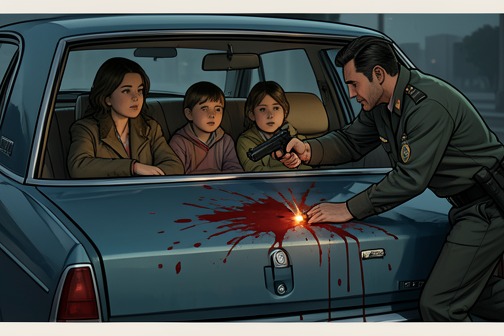
[Arthur’s killing at the GSU checkpoint](entity:event-recall-event-arthur-s-killing-at-the-8b2105546ecd) was a fatal encounter during [Lillian Kagwa](entity:character-recall-character-lillian-kagwa-9e948a4ddb35)’s journey to [Kampala](entity:location-recall-location-291f3a669d32) in 1967. The men at the checkpoint used the authority of the [General Service Unit](entity:organization-recall-organization-general-service-856a5a664bc6) to stop the cousins and demand their car; Arthur was shot when he hesitated to leave his relatives. [Lillian](entity:character-recall-character-lillian-2f0105dc3d76) escaped with the others, but Arthur died before they reached the capital, and the violence strengthened her determination to leave [Uganda](entity:location-recall-location-c04ffded0a14).
## Background and Circumstances
Lillian Kagwa had come from [Jinja](entity:location-recall-location-66b3991111d0), Uganda’s second-largest city, and was traveling to the capital with three cousins when their car was stopped. The country had gained independence from Britain and come under the homegrown rule of Milton Obote, whose government used the army and its secret police, the General Service Unit, to exercise power. The checkpoint encounter took place within this climate of state violence.
Three men claiming to be GSU agents inspected the cousins’ identification. They then ordered Arthur, the only male cousin, to get out and open the trunk. He hesitated because he did not want to leave Lillian and his sisters in the car. One of the men leaned in and shot him.
## The Escape
Lillian was at the wheel. Still disoriented by the sudden shooting, she shifted the car into drive and sped away, weaving across the two-lane road. The men fired at the departing car but could not follow: their own vehicle had run out of gas. They had established the checkpoint to steal a suitable vehicle and would have to wait for another.
Lillian drove on to Kampala, reaching it in half an hour. Her escape carried the surviving cousins away from the checkpoint, but it could not save Arthur. He died before they arrived.
## Aftermath and Significance
The account presents Arthur’s death as both a personal loss and part of a wider pattern of political violence. Lillian regarded an incident like this as scarcely newsworthy in a country where such violence was pervasive. That normalization makes the checkpoint more than an isolated roadside crime: official power and the threat of theft and killing had become difficult to separate in her experience of Uganda.
Lillian wanted out of the country, and a year after the killing she secured a visa to the United States. She came to New York in 1968. The sequence connects Arthur’s death with her departure without reducing her decision to a single event: the checkpoint made the danger of remaining in Uganda immediate, while the surrounding political conditions formed the larger reason she sought a way out.
Event 3
Lillian and Brian meet at Glamour Time
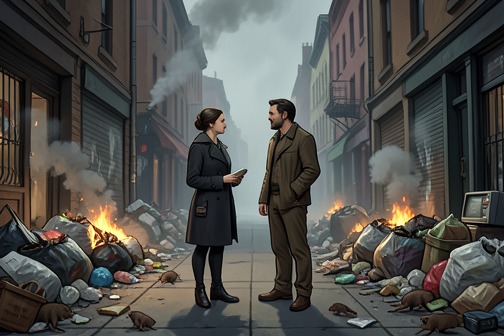
[Lillian and Brian meet at Glamour Time](entity:event-recall-event-lillian-and-brian-meet-c67b922c884c) in 1968, against a [New York City](entity:location-recall-location-new-york-city-65df0a129d4c) buried in strike refuse. The encounter begins a relationship shaped from the outset by attraction, misrecognition, and an awkward conflict of interests: Brian is both drawn to [Lillian](entity:character-recall-character-lillian-2f0105dc3d76) and investigating the agency where she works. Their first meeting does not lead quickly to courtship. Instead, Brian’s professional actions help cost Lillian her job, and she cuts off contact before their first real date, eight years after they meet.
## Background and Setting
The meeting takes place during the eight-day garbage strike of February 1968. One hundred thousand tons of trash accumulated on New York City’s sidewalks and streets; rats ran alongside joggers, and rubbish fires filled the air. The book frames the city’s disorder as a setting with its own “cracked magic”: Lillian and Brian have journeyed from very different places to find one another in [Queens](entity:location-recall-location-queens-6c6ea4959925), though neither could anticipate what falling in love would bring.
Lillian, twenty-five, had emigrated from [Uganda](entity:location-recall-location-c04ffded0a14), where she had lived in [Jinja](entity:location-recall-location-66b3991111d0) through the country’s emancipation from Britain and the rule of Milton Obote. In 1967, while traveling toward [Kampala](entity:location-recall-location-291f3a669d32) with three cousins, she witnessed an agent claiming to belong to the [General Service Unit](entity:organization-recall-organization-general-service-856a5a664bc6) shoot her cousin Arthur after he hesitated to leave the women and open the car trunk. She arrived in New York in 1968 knowing no one. Her English, learned under British rule, helped her find work; the strike’s inconvenience was slight beside the state-sanctioned violence she had left behind.
Brian, by contrast, came from Syracuse. He was a parole officer who visited [Glamour Time](entity:organization-recall-organization-glamour-time-3656a5360872)’s founder, Pavel Aresenyev, a parolee who had served four years in prison for fraud. Brian suspected that Pavel had not gone legitimate. The agency occupied a windowless second-floor office near Queensboro Plaza, far from the centers of high fashion but convenient to working-class aspiring models. Its business was a scam: clients paid for headshots taken by Pavel, who also offered some young women after-hours sessions alone with him. Lillian, answering the phones at the front desk, was the business’s only honest aspect.
## The Encounter
Lillian had been hired as a secretary during the strike. Her command of English was better than Pavel’s, and she could make the agency sound serious, although she did not know it was fraudulent. The job paid three dollars an hour, twice the state minimum wage. After failing to find work in Uganda, she valued the position and its pay.
Brian’s visits had previously been directed at Pavel, but during the week he became more interested in the new secretary greeting him at the desk. He came to the agency four times that week. The narration compares meeting Lillian to finding a rose in a landfill, joining the unlikely romance to the garbage-choked streets outside. The attraction, however, is not presented as effortless recognition. Brian repeatedly mispronounced Lillian’s surname, while Lillian kept mistaking him for other white men. Their errors make the encounter less like instant kismet than a beginning neither initially knows how to read.
Brian was short, stocky, and persistent. Even when he did not appear, Lillian found herself surprised to miss him. His persistence thus registers on both sides: he keeps returning, and she notices his absence, despite her uncertainty about him. The book describes his inability to explain his fixation as if Lillian had cast a spell. That language gives the meeting a fairy-tale charge, while the office’s actual business and the couple’s misidentifications keep it grounded in a compromised, ordinary workplace.
## Attraction and Its Cost
Brian’s attention to Lillian also makes him more troublesome to Pavel. His frequent presence at the agency disrupts the fraud, and Pavel eventually fires Lillian, reasoning that Brian’s interest in her makes her bad for business. Brian continues pursuing Pavel. Charging for headshots was not illegal, but operating a photo studio without a permit violated Pavel’s parole; Pavel returned to jail, and Brian received a commendation. The investigation vindicates Brian’s suspicions, yet its immediate cost to Lillian is the loss of a job she needed and valued.
Lillian moved to an administrative-secretary position at a law firm in midtown [Manhattan](entity:location-recall-location-5e470c74b89c). It paid less, and she moved into a smaller apartment. The commute took an additional half hour each way. She also cut off all communication with Brian: from her perspective, his actions had cost her a good job, and she did not want dinner and a movie with him. Her refusal makes clear that the attraction she had begun to feel did not erase the material consequences of his conduct. Brian’s pursuit of justice against Pavel and his pursuit of Lillian move together, but they do not serve her interests in the same way.
## The Long Delay
Brian gave Lillian space by moving to Staten Island, a borough away, but could not stop thinking about her. Lillian, meanwhile, continued with her life in New York City and did not accept his overture to date. The book gives no quick romantic resolution: they meet in 1968 but do not go on their first real date until eight years later. The gap preserves the importance of the first encounter without mistaking it for the start of an uninterrupted courtship.
The episode’s central irony is that Brian’s visits bring the couple together while also helping to destroy the workplace that first joined them. The city’s garbage strike supplies a vivid backdrop, but the more lasting disruption comes from the collision between Brian’s official duty and Lillian’s precarious livelihood. Their meeting therefore establishes both the force of their attraction and the uneven consequences of Brian acting on it: he is commended and remains smitten, while she loses her job, relocates to less comfortable circumstances, and withdraws from him. The eventual first date comes only after that initial promise has been interrupted by real costs.
Event 4
Lillian and Brian’s first date
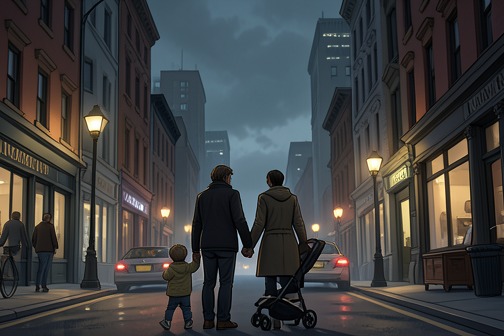
[Lillian and Brian’s first date](entity:event-recall-event-lillian-and-brian-s-fir-89cd24529c84), in late 1976, turns a long-delayed courtship into the start of a family. The evening matters not simply because the couple finally went out together, but because it joined their separate histories in a shared story: a movie, a held hand, and an emerging idea of parenthood that soon became concrete. The account gives this beginning warmth while also marking its limits; the family life it initiates lasts only a few years before Brian disappears.
## Background and Delayed Courtship
[Lillian Kagwa](entity:character-recall-character-lillian-kagwa-9e948a4ddb35) and [Brian West](entity:character-recall-character-brian-west-52d0ec5f8775) had first met during the week of the [1968 New York City garbage strike](entity:event-recall-event-1968-new-york-city-garb-5a7b05eedca1), when both were twenty-five. Their first date came in late 1976, when they were thirty-three. The intervening years are compressed into a striking contrast: [Lillian](entity:character-recall-character-lillian-2f0105dc3d76) had met many men, while Brian had built a life marked by work, sobriety, saving money, and paying his debts. Those qualities now mattered to her. The date is therefore not an immediate romance following their first meeting, but a renewed possibility shaped by time and comparison.
Brian’s desire for a family also had a history. As a boy, he had expected recognition after earning money, but his father instead took the earnings. Brian later told Lillian about that experience. His hope of becoming a husband and father appears alongside this account of what he had lacked as a child: the date gives him a chance to imagine a different kind of family life. When he first saw Lillian at [Glamour Time](entity:organization-recall-organization-glamour-time-3656a5360872), he had already sensed that she would make a wonderful mother. At dinner, however, he spoke so directly about wanting children that Lillian gently reminded him this was only their first date and suggested postponing wedding plans until after the movie. The exchange establishes both his eagerness and her ability to set the pace without ending the possibility between them.
## The Movie and the Change in Their Relationship
Brian took Lillian to see *Rocky*. It was not the film she would have chosen, but halfway through she began to enjoy it and recognized herself in its fierce dreamer. The movie became a possible means of communication between them: the narration suggests Brian may have chosen it to show something about himself that he could not put into words. Their evening thus moves beyond the awkwardness of dinner. In a dark Times Square theater, each had already shared a painful part of a personal history: Brian had told her about his father taking his earnings, and Lillian had told him about Arthur being shot in a car.
The account describes them there as a pair of survivors, together despite the unlikely routes that had brought them to the same theater. Lillian held Brian’s hand. That gesture marks the emotional turn of the date: her earlier caution has given way to a sense of connection, and the story identifies Brian’s easy response to her reminder at dinner as the moment she truly fell for him. He did not respond with anger or wounded pride; he laughed. The smallness of that response matters. His wish for a family is earnest, but Lillian’s affection begins when his eagerness can coexist with her boundary.
## From Shared Idea to Family
The narrative makes the date consequential in a way that exceeds the couple’s later physical intimacy. It locates the beginning of their first and only child in the moment they shared a thought, an idea, and a dream in the theater. Parenthood is presented as a story the two begin telling together, rather than merely as a later domestic fact. The movie, their disclosures, and the held hand all belong to that beginning: they had started to imagine a future before they had yet made a household.
By April 1977, Lillian was showing, and Brian had found them a two-bedroom apartment in [Jackson Heights](entity:location-recall-location-3f4fcb06dcdb). Their son was born in September. Brian thought Rocky would be an odd name for a half-Black child, so they named him Apollo. As a newborn, [Apollo Kagwa](entity:character-recall-character-apollo-kagwa-8242cc572315) was carried in the crook of Brian’s arm, while Brian called him the god and his little sun at bedtime. The movement from the film’s dreamer to the baby’s name links the first date to the life that followed: *Rocky* was not the child’s name, but the evening became part of the story from which Apollo’s name and family emerged.
## The Beginning’s Provisional Ending
The account calls the family’s early years a happily-ever-after, then immediately qualifies the phrase: it lasted only a few years. By Apollo Kagwa’s fourth birthday, Brian West was gone. He had not simply left for another woman or returned to Syracuse; he had disappeared without leaving a trail. That later absence does not cancel the tenderness of the first date, but it changes its frame. What first appears to be a beginning that gathers two survivors into a shared future becomes, in retrospect, the beginning of a family whose stability will not hold. The date’s significance lies in both truths: Lillian and Brian did make a life together, and the promise first imagined in the theater was not permanent.
Event 5
Brian West’s disappearance
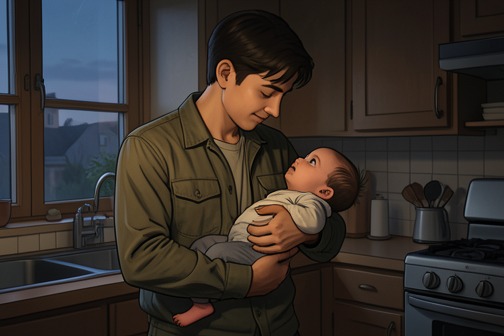
[Brian West’s disappearance](entity:event-recall-event-brian-west-s-disappeara-bbcb27d30a43) is the abrupt rupture in the young family’s apparent happy ending: by [Apollo Kagwa](entity:character-recall-character-apollo-kagwa-8242cc572315)’s fourth birthday, Brian is gone, and his absence becomes a defining fact of Apollo’s childhood. The novel gives no immediate explanation for where he went. Instead, it follows the consequences of an absence so complete that the family’s life divides into before and after, while the unanswered question persists beneath the new routines they build.
## Background and Disappearance
Brian and [Lillian Kagwa](entity:character-recall-character-lillian-kagwa-9e948a4ddb35) had named their son Apollo and settled into a two-bedroom apartment in [Jackson Heights](entity:location-recall-location-3f4fcb06dcdb). Brian liked carrying the newborn in the crook of one arm and murmuring to him; for a few years, the family seemed to inhabit the happy ending that the story briefly promises. That promise is sharply qualified: Brian was gone by Apollo’s fourth birthday.
The disappearance is distinguished from an ordinary departure. Brian had not run off with another woman or returned to Syracuse. He left no apparent trail—not breadcrumbs, not credit-card receipts—and could not be found. The account offers no confirmed motive or destination. Its emphasis on the missing traces makes the uncertainty itself part of the event: Brian is not merely absent from the apartment but seemingly erased from the means by which a person might be followed.
The disappearance also reverses the family’s sense of arrival. Brian and [Lillian](entity:character-recall-character-lillian-2f0105dc3d76) had believed Apollo’s birth meant they had reached the end of their story; in retrospect, that ending was premature. The child’s birth had begun a family, but it did not secure the family against separation. The novel’s fairy-tale language therefore carries an edge: happiness exists, but it does not guarantee permanence.
## Apollo and Lillian After Brian Leaves
Soon after Brian vanishes, four-year-old Apollo begins having the same frightening dream night after night. In it, a man knocks at the door and pushes his way inside after Apollo unlocks it. The man removes his face to reveal Brian’s, then opens his mouth and releases a cloud that fills the apartment. Brian carries Apollo through the fog as the sound of rushing water grows around them. The dream ends with Brian speaking, just before Apollo wakes screaming.
The nightmare affects both mother and child. Apollo no longer wants to sleep, while Lillian cannot close her eyes without anticipating another night of his terror. As she tries to console him, she learns that what makes him cry out is not fear but longing: he wants to know why his father did not take him along. The distinction gives the dream its emotional force. Apollo’s distress is not simply a child’s fear of the frightening figure at the door; it is the pain of being left behind by the person he still wants.
Eventually, the nightmare passes—or Apollo stops talking about it. Daily life resumes in a difficult new arrangement. Lillian works full time, takes classes on Saturdays to become a legal secretary, and raises Apollo alone. The account describes this life as both grueling and rewarding. Apollo grows into a bookish, self-contained, watchful child. Their endurance does not resolve the disappearance; it establishes a way of living around it.
For eight more years, they do not speak of Brian. By the time Apollo turns twelve, neither expects him to become a subject of conversation again. The silence is more than the absence of new information: it becomes a family practice, sustained by a mother and son who have reorganized their lives without expecting an answer.
## The Name and the Return of Contact
With Brian gone, Lillian reverts to her maiden name, and she makes the same change for Apollo. By legal decree, he becomes a Kagwa; the West name is erased from their lives. That formal change gives the family a concrete way to mark its break with Brian, even though it cannot erase the emotional questions his disappearance has left behind.
In the fall of 1989, when Apollo is a junior high school student at IS 237 in [Flushing](entity:location-recall-location-1763c5cfcba3), the long silence is interrupted: he receives a message from Brian, described as a gift. The event does not make the preceding years of absence disappear. Rather, it makes the silence newly unstable. The man whom Apollo and Lillian had ceased expecting to discuss has found a way to reach his son, and the message revives the unresolved connection the family had tried to leave behind.
## Fatherhood, Abandonment, and the Novel’s Contrasts
Later conversations in the novel place Brian’s absence alongside competing ideas of what a father owes his children. [William Wheeler](entity:character-recall-character-william-wheeler-498c91be32f5) describes a model of fatherhood organized around work and provision. Looking back on his own family, he recognizes that earning money did not ensure intimacy: he failed to say aloud that he loved his daughters, assuming his sacrifices made his feelings obvious. His regret illuminates the difference between providing for a family and being emotionally present within it, without offering an explanation for Brian’s disappearance.
The novel also sets paternal abandonment beside more destructive claims made in the name of fatherhood. [Kinder Garten](entity:character-recall-character-kinder-garten-594d97ed2061) describes being abandoned and says that being raised by a man like his father was worse. [Jorgen Knudsen](entity:character-recall-character-jorgen-knudsen-4e40f4294af2), meanwhile, connects his son’s grievances about lost economic security to the son’s decision to renew the family pact with the troll. These later histories are not presented as causes of Brian’s departure. They broaden the significance of the event: absence can wound a child, while appeals to protection, sacrifice, or inheritance can also be used to rationalize harm.
Against those contrasting examples, Apollo’s childhood response remains the most intimate measure of Brian’s disappearance. A father vanishes without a trace; a child dreams of being carried away with him and wakes longing for the invitation he never received. The family changes its name and establishes a demanding new routine, but neither action supplies the missing explanation. The disappearance matters both as a mystery in Apollo’s life and as the formative absence around which his early understanding of family takes shape.
Event 6
The Improbabilia box is left for Apollo
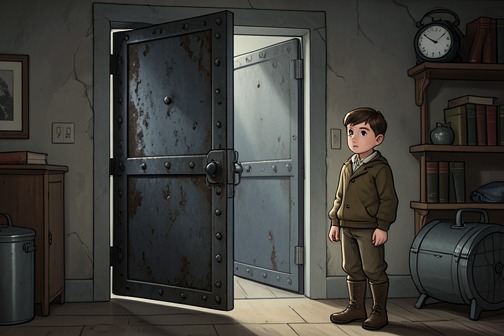
In the fall of 1989, a box marked Improbabilia appears at the apartment door of twelve-year-old [Apollo Kagwa](entity:character-recall-character-apollo-kagwa-8242cc572315), breaking years of silence about his absent father, [Brian West](entity:character-recall-character-brian-west-52d0ec5f8775). Its contents—a marriage certificate, scattered records, and a heavily read copy of [Outside Over There](entity:object-recall-object-outside-over-there-eac421c1b17f)—turn an ordinary afternoon into an encounter with material traces of a family past that Apollo and his mother, [Lillian Kagwa](entity:character-recall-character-lillian-kagwa-9e948a4ddb35), had tried to leave behind. The delivery gives Apollo evidence, not an explanation: its sender remains unidentified, and the objects reopen questions about how a father who kept these mementos could have abandoned his wife and child.
## The silence before the delivery
Eight years had passed since the nightmare Apollo once spoke about. Life had settled into a demanding routine: [Lillian](entity:character-recall-character-lillian-2f0105dc3d76) worked full time, raised her son alone, and had trained to become a legal secretary. Apollo, meanwhile, grew into a bookish, self-contained, watchful child. By the time he was twelve, neither mother nor son spoke of Brian West, and neither expected to make him a subject again. The box arrives against that long-established quiet, making the past present without warning.
The afternoon begins in the loose orbit of a junior high school student with time before he has to go home. Apollo spends a few quarters playing Galaga at a nearby diner, stops at a bodega for quarter waters and chips, then joins a game of running bases on Colden Street. After playing for an hour or three, he heads upstairs. He has not showered for a day or two, and the game has left him sweaty enough that he cannot ignore it. He turns on the shower and is only halfway undressed when heavy knocking starts at the far end of the apartment.
## The dream returns at the door
Apollo initially takes the knocking for a neighbor looking for Lillian and ignores it. The pounding grows louder as hot water fills the bathroom with steam. When he walks into the hall, the vapor seems to flow after him. He feels woozy, as though he has stepped into someone else’s dream, then recognizes the scene as a recurring dream from when he was three or four: knocking at the door, running water, and an apartment dense with fog. The present moment does not settle into a clear distinction between waking and dreaming. Apollo wonders whether he might have fallen asleep in the bathtub, but for the moment the possibility of being in a dream gives him license to approach the door.
He runs toward the entrance, and the knocking stops abruptly. Apollo whispers that he wants his father to wait for him, then repeats himself, embarrassed by how foolish he feels. He reminds himself that Brian West cannot be on the other side. Still, he opens the locks. In the dream, he had somehow reached the top lock as a small child; now, even while feeling as if he is shrinking, he opens it in the real apartment. He hopes for a glimpse of his father’s face, which he can no longer remember clearly. No one is there. Instead, a cardboard box sits on the threshold.
## What the box contains
Apollo looks down the hallway, as if his father might be farther away, but finds nobody. The box is not heavy. One word, written in black marker across the lid, names it: Improbabilia. When Apollo carries it inside, the contents shift and thump. He sits on the living-room carpet and opens it, beginning an investigation into the objects that have arrived without an explanation.
Spread across the carpet are two movie ticket stubs; a headshot of a young white woman; a rental agreement for an apartment in [Jackson Heights](entity:location-recall-location-3f4fcb06dcdb); a bill for an overnight hotel stay on Ninth Avenue, near Times Square; several takeout receipts; a marriage certificate for Brian West and Lillian Kagwa; and a children’s book. The marriage certificate confirms something Apollo had not been certain of: his parents had been married. Lillian recognizes the significance of the collection, but her first response is not an account of its history. She asks where Apollo found it, then—after looking at him and trying to recover her composure—asks whether he found the items in her closet or went through her belongings.
The physical evidence makes Apollo’s questions harder to avoid. How could a man who held on to these things abandon his wife and child? And how did the box reach their front door? Apollo studies its name again, while recognizing that most of the objects will require his mother’s explanation. The delivery offers no accompanying account of who left it, and the records themselves do not resolve the questions they provoke.
## The book as a trace of his father
The children’s book is the one object Apollo can begin to interpret on his own. It is Maurice Sendak’s Outside Over There. He opens it hoping to find a note, a dedication from father to son, or even handwriting that would make Brian’s presence more directly legible. There is no inscription. Instead, the book’s condition supplies a different kind of evidence: its pages are worn, the upper-right corner of each page faintly smudged, and its spine cracked. It has been read repeatedly, not kept pristine for display.
Apollo imagines Brian reading the book aloud to a child, perhaps on the very couch where Apollo now sits. That scene is Apollo’s inference, not something the box proves, but the wear gives his imagination a material foothold. He begins reading the opening words aloud to himself, turning an object associated with his father into an immediate experience of reading. Lillian is not a reader; she works long hours and, in the evenings, often has only enough energy to sit with Apollo and watch television before falling asleep. Once she is asleep, he has long made a private ritual of removing her shoes and wig, turning off the television, and going to his room to read. The book makes him imagine that there may once have been another reader in the home, and that his love of texts might have begun as something shared.
## Aftermath and significance
Lillian briefly leaves the objects to deal with a separate household concern, then returns to the collection and takes the hotel receipt with her. Apollo understands that she is trying to conceal something, but by then he has committed the items to memory and begun connecting them to what he knows of his parents. The receipt’s removal does not erase the other records or settle what the overnight stay meant; it instead sharpens the sense that the box contains a history Lillian is not ready to explain.
The delivery changes Apollo’s relationship to his father without restoring the father himself. Brian remains absent, and the box supplies neither a message nor a clear account of the abandonment. Yet the objects complicate the family story: a marriage certificate records a bond, while the repeatedly handled book suggests that Brian once read it often. Apollo’s appetite for reading grows after the box arrives. Improbabilia therefore functions both as a physical archive and as a provocation: its fragments give Apollo something concrete to study, while their gaps leave him to make connections and imagine the intimacy the evidence cannot confirm.
Event 7
Apollo leaves college to pursue rare-book dealing
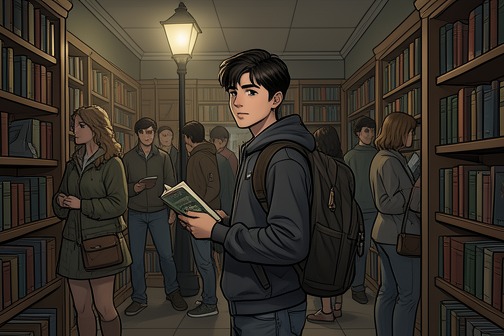
[Apollo Kagwa](entity:character-recall-character-apollo-kagwa-8242cc572315)’s decision not to attend [Queens](entity:location-recall-location-queens-6c6ea4959925) College in 1995 turned an adolescent bookselling enterprise into his chosen vocation. A mentor’s gift, [Confessions of a Literary Archaeologist](entity:object-recall-object-confessions-of-a-liter-e7b64ff8693d), gave him a model for imagining rare-book collecting as a life’s work; Apollo recognized himself in that possibility and chose the uncertain trade over the college place he had earned.
## The Business Before the Decision
Apollo’s commitment to books preceded the choice. At John Bowne High School, where he was a senior, his grades were consistently ordinary: Bs and Cs, much as they had been since ninth grade. Teachers could see that he had intelligence and could study, but his strongest enthusiasm was elsewhere. By seventeen, he had made Improbabilia a thriving concern, known to rare- and used-book dealers in Queens, [Manhattan](entity:location-recall-location-5e470c74b89c), and the Bronx.
His approach brought him into shops as a young Black teenager carrying a heavy pack and introducing himself as Apollo. He would call dealers in advance, presenting his visit as a courteous call from a fellow bookseller. He tried to sell weathered magazines, including The Connoisseur and Highlights. His mixture of entrepreneurial confidence and inexperience could disarm established dealers, some of whom became mentors rather than simply prospective buyers. They taught him how to value books, navigate estate sales, and choose places to sell at antique shows. The trade was already giving him an education, though not one awarded through a school.
## Carlton Lake’s Example
Apollo had been accepted to Queens College in 1995. In the summer before classes were due to begin, one of the dealers who had mentored him gave him a graduation present: Carlton Lake’s Confessions of a Literary Archaeologist. Lake’s account traced his development as a collector of rare books, manuscripts, music scores, and letters from the Napoleonic era. His collection became famous, but the book also described the earlier formation of his taste: reading widely, browsing secondhand bookstores, and beginning to collect with financial help from an indulgent grandmother.
Lake’s account offered Apollo more than a success story. It showed a collecting life taking shape through close attention to books and the discovery of something hidden in one. Lake recounts buying a copy of Baudelaire’s Les Fleurs du Mal at a New York auction and finding the poet’s own corrections in its margins. He called the discovery an illumination; it marked the moment he understood himself as a literary archaeologist and a book man. For Apollo, the anecdote made the trade legible as a calling rather than merely a way to make money.
The contrast between Lake’s circumstances and Apollo’s sharpened the identification. Lake had a grandmother to bankroll his purchases; Apollo did not. He also knew that his knowledge was incomplete: at that point, he did not yet know the difference between Baudelaire and Beatrix Potter. But neither the lack of family financing nor the limits of his expertise persuaded him that the vocation was closed to him. Reading Lake, he concluded that he would not be attending Queens College in the fall. The decision was an act of commitment made before he possessed either Lake’s resources or his accomplishments.
## A Vocation Tested Over Time
The choice did not produce an immediate equivalent of Lake’s celebrated discovery. Apollo had found his direction early, but his first major find in the field came when he was thirty-four. At nineteen he had moved out of [Lillian Kagwa](entity:character-recall-character-lillian-kagwa-9e948a4ddb35)’s apartment and settled in a [Jackson Heights](entity:location-recall-location-3f4fcb06dcdb) studio so crowded with books that a twin bed barely fit. He traveled across the country on book hunts. Other parts of life could interrupt the work—he sometimes took in the sights or dated—but, after those diversions, he returned to books.
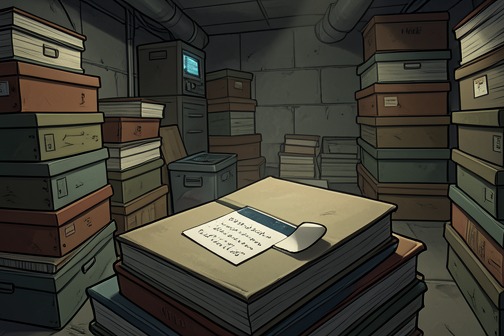
His breakthrough came at a basement estate sale in a Bronx apartment building. The books were packed into forty-two containers, ranging from sneaker boxes to an orange milk crate. The collection belonged to the D’Agostinos, a couple who had died within months of each other. Their four children and eleven grandchildren found the books unsettling, while Apollo recognized a remarkable collection of works on magic and the occult. A snapshot of the couple tucked into a grimoire made the domestic evidence of their lives sit strangely beside the books they had accumulated.
Apollo made a low offer and won the sale after being the first dealer willing to travel to the South Bronx. He rented a van that afternoon and brought the books home. Cataloguing them took a week. As he examined the collection, he noticed marginal notes in two different hands. In a third-edition folio of Witch Hunter Manual of the Blood Council, he found a 1945 postcard addressed to the D’Agostinos and signed by Aleister Crowley. The postcard transformed the cataloguing work into a discovery: the collection held a personal trace connecting its former owners to a famous occultist. The find did not occur when Apollo first chose the trade, but it gave that early choice a concrete, hard-won counterpart to Lake’s auction revelation.
## Books as Work and as Evidence
Apollo’s later dealings show the different kinds of value his vocation taught him to recognize. When he showed [Emma Valentine](entity:character-recall-character-emma-valentine-118b416ffa0a) a true first edition of To Kill a Mockingbird, he pointed out its original cover and fine condition, estimating that it was worth five thousand dollars and might be worth at least twice as much after Harper Lee’s death. He also opened it to the title page, where Lee had signed the book to Pip, her childhood best friend, who had become a writer. The copy’s edition, condition, signature, and dedication made it at once a collectible and a record of a relationship.
Books also recur outside the marketplace, bearing traces that matter for reasons other than price. In another scene, Gretta says that a book has been ruined because someone wrote one thing across every page. Earlier, a collection of objects left at Apollo’s door included a children’s book among movie stubs, a photograph, a rental agreement, a hotel bill, food receipts, and a marriage certificate for [Brian West](entity:character-recall-character-brian-west-52d0ec5f8775) and Lillian Kagwa. These objects are not evidence that every book in Apollo’s life is a collectible; rather, they show how a book can sit among records that expose personal histories. The distinction gives his profession a wider narrative resonance: he learned to inspect the physical evidence books contain, while the story repeatedly places books alongside the evidence of people’s lives.
Apollo’s refusal of college is therefore neither a rejection of learning nor an instant triumph. His training came through dealers, shop visits, estate sales, and the slow accumulation of judgment. Lake’s book supplied the example that helped him name what he was already doing; the years before his first great find show the delay between choosing a vocation and receiving its defining reward. Apollo’s path makes the decision consequential precisely because it begins with conviction, continues through practical labor, and is tested over time.
Event 8
Apollo’s D’Agostino collection discovery
[Apollo Kagwa](entity:character-recall-character-apollo-kagwa-8242cc572315)’s discovery of the D’Agostino collection began as a rare-book dealer’s windfall and became a reckoning with the life he wanted. In a Bronx basement, among forty-two containers of books, Apollo found a cache of occult volumes whose value was exceeded, for him, by what their traces revealed about the couple who had owned them. The collection’s most startling item—a postcard signed by Aleister Crowley—made the find potentially legendary. Its deeper significance emerged later, when Apollo recognized two distinct hands in the books’ margins and understood the collection as evidence of two people studying together over many years.
## The estate sale and the collection
Estate sales offered Apollo both risk and surprise: a trip might yield water-damaged books in a garbage bag or, as at a townhouse in Sugar Hill, shelves of preserved first editions. He had pursued book dealing since early adulthood, living among books in a crowded [Jackson Heights](entity:location-recall-location-3f4fcb06dcdb) studio and traveling across the country on book hunts. Yet his first great discovery in the business did not come until he was thirty-four.
That discovery was at an estate sale in the basement of a Bronx apartment building. The books filled forty-two containers, ranging from sneaker boxes to an old orange milk crate salvaged from a supermarket. Among them were some of the rarest books on magic and the occult Apollo had encountered. Their former owners, Domenico and Eliana D’Agostino, had died within months of each other. The collection had unsettled their four children and eleven grandchildren, who were left with books that seemed far removed from the ordinary image suggested by the couple’s family snapshot.
Apollo found that photograph tucked into a grimoire. It showed an old couple whose homely appearance seemed incongruous with the volumes of sorcery surrounding it. That contrast almost made him laugh in front of the family. The collection’s unusual contents were not merely an amusing mismatch, however: they would become part of the evidence that the books had belonged to a shared intellectual life.
## The sale and the postcard
Apollo made a low offer at the sale. Because he was the first dealer willing to travel to the South Bronx, he secured the collection. He rented a van that afternoon and brought the books home. Cataloging them and uploading information about the relevant volumes took a week, a practical stretch of work between the excitement of acquisition and the moment the collection’s most surprising item emerged.
While examining a third-edition folio of *Witch Hunter Manual of the Blood Council*, Apollo found a postcard addressed to the D’Agostinos. It had been stamped in 1945 and had not yellowed as much as he expected. Its sender’s name and signature were unmistakable: Aleister Crowley. A quick online search confirmed that Crowley had been a celebrated occultist in the early twentieth century, notorious for his reputation and controversial pursuits. The postcard’s brief, bawdy note, followed by a personal expression of remembrance, connected the couple’s private collection to a figure whose name alone could make the find extraordinary.
The card changed Apollo’s estimate of the haul. The books had already made it his best find; if the postcard could be authenticated, the collection might become legendary. Apollo thought of the contrast between Carlton Lake’s discovery of Baudelaire’s corrected texts and his own prize: an irreverent postcard from Crowley. He read it again, laughed, and lifted it as if to share the joke. Only then did he register that he was alone in his living room.
## A discovery that changes meaning
The postcard was a potentially valuable object, but the collection’s significance shifted when Apollo looked again at the books themselves. He scanned the card and considered the couple’s apparent adventures in occultism. In the margins, he had found notes in two different kinds of handwriting. Those marks suggested that both spouses had read and studied the books, leaving comments that answered or accompanied one another. The volumes could thus be understood not only as merchandise or as a startling collection, but as the surviving record of an ongoing conversation between two people.
That recognition sharpened the contrast at the heart of the discovery. Apollo had acquired a rare and perhaps exceptionally valuable collection, but its evidence of companionship also made his own isolation newly visible. No one was there when he found the postcard; no one shared the joke or the excitement of the possible authentication. His feeling moved from surprise at the find to a strong sense of loneliness.
At three in the morning, in his one-bedroom apartment and surrounded by a small library of occult texts, thirty-four-year-old Apollo realized that his biological clock had started. The D’Agostinos’ books had first appeared to him as an excellent payday, then as the record of a couple’s shared life. In bringing that shared life into focus, the collection also made Apollo confront his own desire for a life beyond solitary work. The discovery’s decisive consequence was therefore not just a new prize in his business: it changed what he saw when he looked at the books, and what he understood about himself.
Event 9
Apollo meets Emma Valentine
[Apollo meets Emma Valentine](entity:event-recall-event-apollo-meets-emma-valen-efc64ed80f6c) at the [Fort Washington branch](entity:location-recall-location-101efeda2e1e) of the [New York Public Library](entity:organization-recall-organization-new-york-public-0a1097f28acf), where her composure in a small public confrontation becomes the first impression that draws him back. What begins as a stop at a basement book sale turns into a patient courtship: Apollo asks Emma to dinner, she declines, and he returns week after week until she gives him her name and, five months after their first meeting, agrees to a date.
## Background and Setting
Apollo had come to [Washington Heights](entity:location-recall-location-a5ecb618eb55) for an estate sale that yielded nothing, then stopped at the Fort Washington branch. He was familiar with library sales as a modest but useful part of his rare-book business. Such sales offered worn books the branch meant to sell rather than recycle, alongside donations from local residents. They were not likely to produce a collection like the D’Agostino books, but a fifty-cent purchase might be resold for five dollars. Apollo valued the margin as practical business, even if he found little romance in it.
The books he sought there were often large-print crime novels, which he shipped to retirees who had found his website. The work recalled his earliest business model: selling People magazine to Mrs. Ortiz in apartment C23. This was a routine commercial stop, not an appointment arranged to meet anyone. The basement sale occupied a nook beside the reading room, and one librarian had to cover both the sale and the main desk. When Apollo arrived, she was helping a mother and two children choose picture books. The younger child repeatedly pulled books from the shelves and onto the floor, leaving the librarian to manage cleanup as well as the sale and desk.
## The Visitor and Emma’s Response
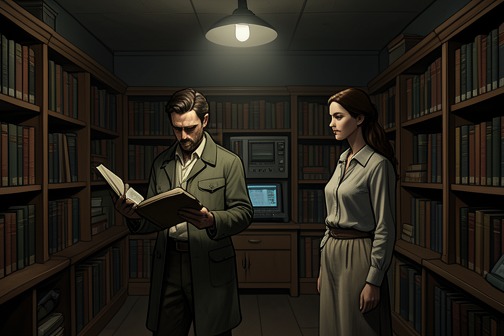
A man called out from the reading room, his voice so loud in the quiet space that it seemed amplified: “Hello! Hello! I am in distress!” He was enormous, wore a bulky old backpack, and carried shopping bags crammed full in both hands. He announced that he urgently needed a toilet. Rather than yield to the volume of his appeal, the librarian asked why he was shouting; she pointed out that she could hear him without it.
The practical obstacle was that the bathroom key was kept behind the desk, and the librarian required identification before handing it over. The man had none. She opened a drawer and brought out a two-foot wooden ruler with a key attached to its end by a string. Using the ruler to indicate what she wanted, she told him to leave his bags with her and assured him he would come back for them. He resisted, clutching the bags close and saying, “These contain secrets.”
Emma did not escalate the exchange. She put the ruler away, closed the drawer, folded her arms, lifted her face to look directly at him, and waited. Apollo watched until the man set down the bags; the backpack followed only after he asked whether that too had to be left. Emma’s answer was simple: “All the bags.” She then gave him the key. His thanks, delivered softly, contrasted with his earlier shouting, and Emma answered warmly. The room listened as he fumbled with the key and opened the wooden bathroom door. When it shut, the people in the reading room seemed to emerge from the spell of the encounter. Emma had already moved on, returning to the mother and children, who bought four books for a dollar.
## Apollo’s First Impression and Courtship
Apollo had been standing dumbstruck. He told Emma he had been about to help her with the man, then acknowledged that she had handled the situation herself. Her answer, “That’s my job,” made the division between them plain: Apollo had watched himself prepare to intervene, but Emma had already taken charge of the problem in front of her. The scene introduces her through action rather than explanation. She protects the order of the room, secures the visitor’s bags, and gets him the bathroom key without surrendering control of the encounter.
Apollo asked Emma to dinner as she rang up his three books. She politely declined. The refusal did not end his interest, and the regular schedule of the sale gave him a reason to return: it was held in the basement nook every Friday. He came back the following week, and then the week after that. Only eventually did Emma tell him her name. The progression is measured in repeated visits rather than an immediate change of heart; Apollo’s interest is clear, while Emma decides when to share even this first piece of personal information.
## The First Date
Five months after they met, Emma finally agreed to go out with Apollo. Trying to impress her, he chose a small sushi restaurant on Thompson Street. They had to wait outside in late fall, in weather cold enough to make standing on the sidewalk feel like being inside a refrigerator. By the time they were seated, they were shivering, and they drank a bottle of hot sake before any food arrived.
The date also brought the first limited account of Emma’s family background. She said she had grown up in [Boones Mill](entity:location-recall-location-28938fad64d7), Virginia, and had a sister, [Kim Valentine](entity:character-recall-character-kim-valentine-7f8a535a5bd7), who was eleven years older. Her parents had died when Emma was five, but she would not say more about their deaths. The disclosure establishes both a loss in her childhood and a boundary around it: Apollo learns the fact, not the story behind it. In retrospect, the meeting’s defining pattern is already visible. Apollo returns and waits; Emma offers what she chooses, first her name and later a brief account of her past. Their relationship begins not with a grand declaration but with a practical encounter, a declined invitation, and the persistence of Friday visits.
Event 10
Emma’s Brazil journey and return
[Emma Valentine](entity:character-recall-character-emma-valentine-118b416ffa0a)’s [Brazil](entity:location-recall-location-ff48c498ec8a) journey and return mark the first long separation in her relationship with [Apollo Kagwa](entity:character-recall-character-apollo-kagwa-8242cc572315), and make his devotion visible through the choices he makes while she is away. She leaves with a ticket already bought and no fixed plan for how long she will stay; a year later, she returns to find Apollo waiting through a night of airport delays. The journey’s decisive movement is not simply from New York to Brazil and back, but from the possibility of romance to a separation neither can confidently predict, and then to a reunion that confirms Apollo has not let go.
## Departure and Uncertainty
Apollo and Emma’s first date had followed months of his returning to the library’s Friday basement sales after she initially declined his invitation. Their late-fall dinner at a small sushi restaurant on Thompson Street began with them shivering outside in a long line; after they were seated, they drank hot sake before the food arrived. The relationship advanced through further meetings, but when Apollo asked whether he could persuade her to stay, Emma told him she was moving to Brazil. Her tickets were already purchased. She planned to go to [Salvador](entity:location-recall-location-6f541c528920), in the north, but could not say how long she would be gone.
Four weeks later, Emma left. The interval gave Apollo little time to turn her announcement into anything more certain: departure was imminent, and its duration remained unknown. The journey therefore begins not as a clearly bounded trip but as an open-ended absence. Emma’s decision establishes a practical distance between them at the moment when Apollo most wants the relationship to continue, while her inability to specify a return date leaves that distance unresolved.
## The Months Apart
Apollo tried dating other women after Emma left, but found that his heart remained fixed on her. They wrote to one another, although Emma could not rely on having an Internet connection. Her route carried her from Salvador to Manaus and then Fortaleza; she might eventually visit Rio and São Paulo, but had not yet done so. The account traces her movement through named cities without turning it into a complete itinerary. Its emphasis is instead on the uncertain, continuing separation and the limited contact available across it.
Apollo’s attention remained attached to Emma even in her absence. He read news from Brazil online and obtained a DVD of *Quilombo*, a serious film about African slaves fighting the Portuguese. Watching it, he imagined Emma at twelve, repeatedly viewing the film in the public library in Roanoke. The recollection links the woman he misses to the childhood she had described, and to the library that had been one of the few places in her life after her parents died. The film does not bring Emma physically closer, but Apollo’s imagined connection to her past shows how absence redirects his attention toward what he knows of her.
The year apart also has a material, everyday rhythm. Apollo sold the D’Agostino library piecemeal and listed Aleister Crowley’s postcard on his website; within fourteen hours it had attracted five bids, and it ultimately sold for three thousand dollars. In late 2003, he helped [Lillian Kagwa](entity:character-recall-character-lillian-kagwa-9e948a4ddb35) make a down payment on a house in Springfield Gardens. She initially refused his help, but they calculated together how much she would save by putting down 30 percent rather than 20 percent, and she accepted. The narration explicitly presents this work and practical family support as ways Apollo occupied his time and mind. They give the absence a lived duration: while Emma travels, he continues to work, help [Lillian](entity:character-recall-character-lillian-2f0105dc3d76), and wait.
## The Return Flight
After a year, Emma wrote that she was coming back to the United States. She warned that her flight would arrive late at night and allowed for the possibility that Apollo might no longer want to see her. If he did, she said, she would love for his face to be the first she found in arrivals. Her message makes the reunion conditional rather than assumed; it asks whether the attachment has survived without claiming that it must have. Apollo’s answer is to go and wait.
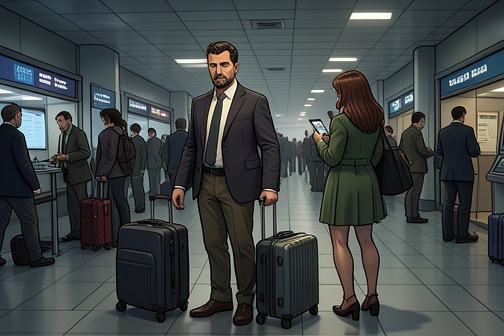
The flight, scheduled to arrive at ten, was delayed twice, leaving Apollo at [John F. Kennedy International Airport](entity:location-recall-location-f-9ffe230e6d2d) for the night. Around him, families and friends in the arrivals area slumped, shuffled, shrugged, and sometimes fought as the delays dragged on. Apollo stayed among them, eventually falling asleep sometime after midnight. Other delayed planes arrived at intervals, bringing weary passengers to meet equally weary loved ones. The long wait places his reunion within an ordinary crowd of separations and arrivals, while the delay extends the uncertainty of whether Emma will appear.
## Dawn Reunion
Dawn light entered the international arrivals terminal through its large windows when Emma’s plane finally landed. Her return was marked by visible change: her hair had grown longer and curlier, with a faint reddish cast; her skin was darker, and she wore bright, thin clothes that seemed wrong for the cool spring weather. She had no suitcase, only a backpack over one arm. She had left with more and returned with less, and she moved slowly, seeming weary but unrushed. Before Apollo saw her, she saw him.
As Apollo took her pack, Emma asked, “You stayed?” Her eyes grew wet and trembled, perhaps from exhaustion; then she repeated, quietly, “You stayed.” The repetition gives the reunion its emotional center. Her question is answered not by a declaration but by the fact of his presence after a night spent waiting through two delays. The journey’s separation has made staying legible as an action.
They sat in the food court and ate egg-and-cheese sandwiches from Dunkin’ Donuts. Apollo welcomed her back to America and said he would take her somewhere nicer soon. Emma pulled up her sleeves, said, “Fique tranquilo,” and smiled as she assured him she would not keep doing that. The modest meal and their exchange make the reunion intimate without suggesting that the year apart has been erased: Emma has returned changed, and Apollo’s welcome begins with what is available in the airport. The episode closes on her return and their renewed proximity, not on a grand resolution of what comes next.
Event 11
Apollo cuts Emma’s wish string

[Apollo cuts Emma’s wish string](entity:event-recall-event-apollo-cuts-emma-s-wish-21d6ab048477) during her return from [Brazil](entity:location-recall-location-ff48c498ec8a), transforming an object tied to a private ritual into a decisive gesture in their relationship. The scene brings together Emma’s belief that the string must fall away naturally, Apollo’s impulse to take action on her behalf, and the unresolved choice of how she will understand that intervention.
## Background and the String’s Meaning
Emma explains that after arriving in [Salvador](entity:location-recall-location-6f541c528920) she stayed with a family in Itapuã. Nearby was Lagoa do Abaete, a lagoon she associated with a story Apollo had once told her about an old married couple who were Satanists. There she came to know a washerwoman as her Portuguese improved. Emma’s host family warned her away, calling the woman a witch, but Emma was drawn to her rather than frightened. The woman reminded her of the mother Emma had lost: tough, funny, and unconcerned with other people’s opinions.
Emma began slipping out of the house to sit by the lagoon while the washerwoman did her laundry. Before Emma left for Manaus, the woman told her to make three wishes for her life and tied a red string around her wrist. The string was not simply a souvenir of travel: its continued presence marked Emma’s commitment to the rule she had been given. It could not be cut; the wishes would come true only when the string came apart and fell off by itself.
By the time Emma tells Apollo about it, she has worn it for more than six months. She turns her hand back and forth to examine the fabric, which has become stiff and dirty. She admits that she had first treated the ritual as a bit of fun, but the string’s persistence has made her want the wishes to come true. Her account holds playful mysticism and genuine attachment together: she knows how ratty it looks, yet does not want to remove it by breaking the rule.
## The Cutting
Apollo has been watching Emma since she returned after a year away. At the meal, the string makes him stiffen; he wonders whether it signals an attachment formed in Brazil and whether her smaller amount of luggage means she plans to return there. As Emma eats, he pushes his own egg-and-cheese sandwich around without appetite. Her explanation gives the object a history, but it does not quiet the anxiety that its presence has stirred in him.
After Emma describes the ritual, Apollo takes her hand and pulls it toward him. He silently repeats the thought that he is the god Apollo, then picks up the plastic knife from the table and cuts the string in one motion. It falls onto the plastic tabletop. The action is deliberately at odds with the washerwoman’s instruction: Apollo does not wait for the string to wear away, and he does not ask Emma to release it. He uses an ordinary table knife to end a practice Emma has preserved through months of wear.
Emma shivers. Apollo continues holding her hand and promises that, with him, all three of her wishes will come true. The promise answers the ritual on its own terms, but the means are different. The washerwoman’s rule depended on waiting for the string to fall naturally; Apollo substitutes his own intervention and offers himself as the assurance that the wishes will be fulfilled.
## Choice and Significance
The scene does not establish whether Emma’s wishes come true, or whether Apollo’s promise can fulfill them. Its immediate consequence is instead a choice about how to read his act. Emma can take the cutting as proof that Apollo is arrogant, or see it as boldness and worthiness. The narration leaves that judgment with her: Apollo has made his move, but the meaning of the gesture depends on her response.
The red string concentrates the scene’s tension between belief and agency. Emma’s account gives the object a specific origin, a prohibition, and a hoped-for future; Apollo’s knife abruptly changes its condition without resolving those hopes. His promise makes the cut intimate, but does not erase its presumption. The moment therefore turns on more than whether magic is real: it tests whether an act presented as devotion can also override another person’s chosen terms. Emma’s decision remains open at the scene’s end.
Event 12
The Valentine family house fire
[The Valentine family house fire](entity:event-recall-event-the-valentine-family-ho-a2e4ef229341) is the childhood catastrophe that takes [Emma Valentine](entity:character-recall-character-emma-valentine-118b416ffa0a) and [Kim Valentine](entity:character-recall-character-kim-valentine-7f8a535a5bd7)’s parents and reshapes the sisters’ lives. Recalled by [Kim](entity:character-recall-character-kim-daaac0827eb9) years later, the fire is more than an account of escape: it exposes how a family history was softened and withheld, and how Emma, still only five, became the person whose words allowed the other survivors to leave.
## The memory returned
The event enters the story as Kim’s account to Emma, not as an uninterrupted scene from the past. On April 14, 1988, Kim says, “You don’t remember the day as well as I do.” Emma initially answers that she remembers what Kim has told her before, but the remembered version is incomplete. Kim admits that the familiar story—that the sisters returned from school to find fire engines outside—was not what happened. “Today I’m going to tell you what happened.” The change in who tells the story matters: the fire is first approached through a version Kim had repeated for years, then reopened as a memory she had kept from Emma.
Kim’s account begins with an unusually domestic day. The sisters were home rather than at school: their mother had let them stay in until their father returned from an overnight shift. Their father came home tired and angry that the girls were making noise when he needed to sleep. Their parents argued; their mother insisted, “I want them close!” Their father eventually went to bed, while their mother stayed with the girls. She did Emma’s hair, tried to do Kim’s despite their strained relationship, and watched television with them. Kim was sixteen and thought she might go find her friend Shelby after lunch. The details make the day legible as ordinary before its danger becomes clear—and, in retrospect, as a day whose exceptions Kim recognized only too late.
The television schedule and the meal remain in Kim’s memory as fragments of that ordinary routine. The girls watched *Card Sharks*, *The Price Is Right*, and then *The Young and the Restless*. Their mother made soup and required them to eat it in the living room, an unusual break from the household rule against bringing food or drink there. Kim cannot remember what kind of soup it was; she remembers that it tasted terrible. When she next recalls their father standing over them, the house is hot and full of smoke. His words are disconcertingly calm: “Better get up.”
## The fire and the escape
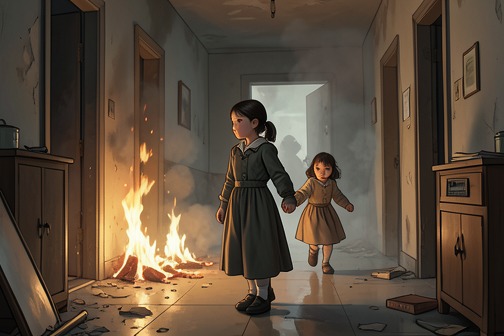
Kim remembers that her soup bowl had overturned in her lap, as if she had spilled it and fallen asleep. She was too foggy to get up by herself. Their father lifted both girls, one over each shoulder, despite his small, thin frame. From there Kim could see the house burning, though smoke obscured her view. He carried the children into the kitchen, where their mother was sitting at the table with a half-finished bowl of soup. Kim names the cause plainly: “Mom set the goddamn fire.”
Their father tried to take the girls out through the kitchen. Their mother shouted at him, pulled Emma from his shoulder, and held her tightly in her lap. Emma remained calm; Kim, frightened and crying, could not understand how still her younger sister was. The parents were again locked in a fight, but now the house itself made their conflict immediately lethal. Their father shouted for their mother to let Emma go. Kim begged as well. Their mother said she did not want to leave the girls as orphans to face a cruel world alone; in her view, it would be better if they died with her. Her embrace, an act Kim understood as a desperate refusal to abandon her daughters, had become a physical barrier to their escape.
The reversal comes through Emma’s quiet intervention. Kim remembers her sister turning to their mother and saying, “Let go.” Emma did not shout, yet Kim recalls that everyone heard her, almost as if the words had reached them inside their heads. Their mother opened her arms. Emma climbed down and took their father’s hand; he took both girls outside. Kim’s memory makes no further claim about how to explain the force of Emma’s words. It records their effect: the grip loosened, and the children got out.
Their father then went back toward the burning house. Kim thought he was returning to rescue their mother, but at the kitchen door he looked back at her. She remembers his exhausted expression and the way he grasped the hot door handle before going inside with his wife. Kim’s recollection gives this return a stark, unresolved weight: she can only describe what she saw, not what her father intended to communicate in that last look. Emma asks whether he died in the fire too, and Kim answers that he went back inside with their mother. Together, the account establishes the parents’ loss while preserving the child’s limited view of their final moments.
## Aftermath and the story Kim withheld
Emergency medical technicians took the sisters to hospital for smoke inhalation, and they remained there for five days. Afterward they entered foster care with Nathan and Pauleen, a couple Emma remembers through Pauleen’s oatmeal cookies. That small surviving detail sits beside the loss without undoing it: the girls’ next home is not their parents’ home, but it includes care that Emma can still recall affectionately.
When Kim turned eighteen, she applied to become Emma’s guardian. She says that arrangement lasted until Emma finished high school. The fire therefore altered their relationship as well as their home: Kim became responsible for her younger sister after the parents’ deaths, and the sisters’ shared past was filtered through the older sister’s decisions about what Emma should know. Kim acknowledges that she had not planned to tell Emma the full account. Because Emma appeared not to remember the fire, Kim decided not to remind her, believing she was protecting her.
The disclosure takes place years later, while Kim and Emma are together in a playground. Kim has chosen a story rather than direct questions to reach her sister, and she narrates the fire while Emma walks with a heavy bag of chains. The remembered event is thus presented through two kinds of evidence: Kim’s detailed recollection and Emma’s limited recognition of what she has been told. The difference is not resolved by the telling. Instead, Kim’s decision to speak makes the family’s history newly available to Emma, including the fact that the account she had heard for years was not true.
## Narrative significance
The fire’s most consequential reversal is that a mother’s declaration of love and closeness becomes entangled with danger. Earlier that day she had insisted that the girls stay near her; as the house burned, she again clung to Emma, now saying that her daughters should not have to live as orphans. The same protective language takes on a terrible consequence when it prevents their escape. Their father, who had first carried both girls out, then reenters the house with their mother, leaving Kim to remember his last look without knowing what it meant.
The memory also places responsibility for survival in the hands of the youngest child. Emma does not lead the others out through physical strength or an elaborate plan; her two words change what their mother does. Kim’s recollection presents the moment as something she cannot fully explain, while staying precise about what follows: their mother releases Emma, Emma takes their father’s hand, and the girls leave the house with him. In the larger family history, the fire is therefore both a death and an origin: it ends the sisters’ life with their parents, begins Kim’s guardianship, and leaves a story that Kim thought silence could protect Emma from.
Event 13
Brian’s birth on the stalled A train
[Brian’s birth on the stalled A train](entity:event-recall-event-brian-s-birth-on-the-st-dfebe5a2b353) transforms a carefully planned home delivery into an emergency that Apollo and Emma face together in a dark subway tunnel. With [Kim Valentine](entity:character-recall-character-kim-valentine-7f8a535a5bd7) absent and help delayed, Apollo assists Emma through labor, catches their son, and gives him the name of his missing father. The scene joins the physical danger and exposure of childbirth to a private family revelation: at the moment he becomes a father, Apollo discovers that he wants to pass on the name Brian.
## Background and the journey
The choice to have the baby at home had come largely through Kim Valentine, Emma’s sister, who had shifted from pediatric nursing to midwifery and became an enthusiastic advocate for home birth. She had raised Emma since Emma was five, and regarded becoming her baby’s midwife as a milestone. Apollo initially had questions, but not objections; after [Kim](entity:character-recall-character-kim-daaac0827eb9) and Emma told him their plan over brunch on Fort Washington Avenue, he spent the day researching inflatable birthing pools. Their agreement included a contingency: they would go to a hospital if necessary, and Emma had packed a small suitcase for that possibility. They had also taken [Bradley Method](entity:concept-recall-concept-bradley-method-5fbc43a74f05) classes, where Apollo learned how to support Emma during labor. He believed he could help deliver a baby, though he had assumed he would never actually need to.
On the night of the birth, Apollo and Emma boarded the A train at Chambers Street. They were so preoccupied that they barely registered the other passengers. Emma stood holding a pole, with Apollo behind her so she could lean back against him. As labor intensified, she concentrated on her breathing while the train made the long, difficult run toward 125th Street. Apollo tried to brace her against the train’s jolts, but her practiced breathing was the more effective comfort. The ordinary journey home was already narrowing into a test of whether their preparations could hold under circumstances they had not planned for.
## The train stops
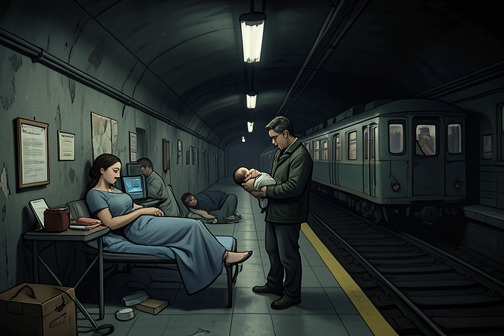
The wheels creaked as the train slowed, then the cars came to a full stop. Apollo looked into the darkness outside; a burst of feedback came through the speakers, and then the lights throughout the train went out. Emma, Apollo, a mother with children, and four young dancers were left in the dark. With no midwife in sight, Apollo had to face the possibility that the birth would happen there. Emma made the low, sustained sound they had learned in class as the pain became too strong to manage through breathing alone.
The four dancers approached Apollo, one holding up a phone as a makeshift flashlight. Their oldest member, a boy of about fifteen, thought Apollo was hurting Emma and confronted him with clenched fists. When Emma calmly explained that she was starting labor, the boys’ alarm shifted; the leader’s fists loosened. Apollo asked them to find the conductor. They hesitated until Emma repeated the request and met their eyes. One eventually returned with the conductor, who explained that the train had lost power to the third rail. It could not move, and although he would radio for emergency medical technicians, they would take time to arrive.
Apollo understood that professional help could not reach Emma in time. As the conductor left, faces gathered behind the glass of the next car, and passengers began raising cell phones to record the scene. Apollo asked the dancers to block the windows and keep spectators out. They turned their backs to the labor and flailed their arms to stop people from filming, creating a small screen of privacy in the crowded train. Apollo removed Emma’s shoes and lowered her tights, then used the pressure on her hips that had soothed her during pregnancy. He told the baby, “[We can’t wait to meet you](entity:expression-recall-expression-we-can-t-wait-to-m-e7983a7b749b),” shifting his attention from the watching passengers to the child about to arrive.
## Delivery and naming
In the stalled car, Apollo stayed focused on Emma and the baby. He repeated the two brief instructions Kim had taught him, pressed his thumbs into Emma’s lower back when she arched, and supported her as she bore down. When the baby’s head appeared, Apollo was startled to see it still enclosed in the unbroken amniotic sac. The sac remained between the baby and Emma’s pelvic bone until her water broke; then Emma expressed relief, the child slipped free, and Apollo caught him before he touched the floor.
Apollo announced that the baby was a boy, and Emma repeated the news. She leaned against the woman beside her and remained on her knees until the placenta passed. For a short time Apollo was alone with his newborn son. He unbuttoned his shirt to hold the baby against his bare skin and watched him take his first gasping breaths. The birth had made Apollo both witness and participant: after having imagined childbirth as an ability he would never need, he now held the child he had just helped bring into the world.
In that first, stunned interval, Apollo asked Emma whether they could call their son Brian. He had not planned to choose that name at the moment of birth, or expected to name a child after his missing father, [Brian West](entity:character-recall-character-brian-west-52d0ec5f8775). The wish seemed to emerge from years of silence rather than from a decision he had prepared. Emma agreed that she liked the name. Apollo touched his cheek to the baby’s and whispered, “Hello, Brian,” followed by, “I’m so happy to meet you.” Naming the boy links the new family’s beginning to the unresolved absence in Apollo’s own history, without suggesting that the name resolves that absence.
## After the birth
The boy was born on Friday night. Emergency medical technicians arrived twenty-two minutes after Apollo and Emma first met him. Emma had predicted that she would be taken to [Harlem Hospital](entity:location-recall-location-3cab0d9a5453), where she and the baby remained under observation for two days. Although Apollo was told he could go home, he spent both nights upright in a chair in Emma’s room. By Monday morning, the three of them were home in a taxi, and Apollo helped Emma and the baby into bed.
Apollo held the newborn with extraordinary care, as though he were made of Baccarat crystal. When the question of a middle name arose, Emma rejected Cowboy—the name Apollo had apparently considered—as she prepared to climb into bed. She propped pillows behind herself, and Apollo handed her the baby. The scene closes not with a return to the original home-birth plan, but with the family together at home after an emergency delivery: the new parents pass their son between them, while the name Brian carries Apollo’s past into the child’s first hours.
Event 14
Apollo discovers the signed first edition of To Kill a Mockingbird
## The search and discovery
Apollo finds the book while working through a series of boxes in a basement in [Riverdale](entity:location-recall-location-riverdale-16b7637b401e). The search has not been an uninterrupted run of treasures: the sixth box contains hardcovers marked by black spots on their endpapers, books Apollo judges ruined and worthless. With one box left, he is sorting through the final container while also caring for his infant son, Brian. When Brian falls asleep, Apollo chooses to take his time with the last box, partly to delay checking the response to the eleven photographs of the sleeping baby that he has just posted online.
That pause gives way to an abrupt change of pace. After finding the book, Apollo rushes home with it and enters the apartment shouting that he has found it. Emma initially thinks something may have happened to Brian, but Apollo is holding the book out in front of him. His excitement has already carried him through the drive home: he has repeated the same words along the Henry Hudson Parkway and even been stopped by police for driving below the normal speed of traffic. The book’s arrival is staged amid ordinary domestic noise, with the television on, the breast pump running, and Brian with his parents. Apollo’s discovery interrupts the household before he can explain why it matters.
## The book and its inscription
Once Apollo and Emma are sitting together, he shows her the volume. Emma reads the title, and Apollo opens the book to the copyright page to identify it as a true first edition with its original cover and in Fine condition. He estimates that condition and edition alone would make it worth five thousand dollars, and speculates that the price might at least double after Lee’s death. These are Apollo’s projections, not a completed sale or an independently established valuation.
The title page reveals the feature that makes this copy still more remarkable: Lee has signed it. Apollo explains that Lee rarely signs books, then points out that the dedication is addressed to someone called Pip. Emma recognizes the name as Truman Capote, and Apollo explains that Capote was Lee’s childhood best friend and later became a writer in his own right. Emma, a librarian with a strong sense of the book’s significance, grips Apollo’s leg and looks at the volume with new reverence. The discovery is no longer simply a valuable edition: its signature connects the book to a personal relationship between two writers.
The inscription reads, “Here’s to the Daddy of our dreams.” Apollo treats those words as the exceptional detail that elevates the find beyond an already valuable first edition. The dedication addresses Capote through an affectionate phrase, while the book’s arrival takes place in a room where Apollo and Emma are caring for their own baby. The scene brings literary history and new parenthood into close proximity without reducing the inscription to a price tag: its potential public interest and its private resonance coexist.
## From purchase to imagined future
The book had come from a transaction Apollo later recalls in detail. At the side door of the Riverdale house, he asked for the old woman’s son and tried to sound calm. The man would not let him enter the house and suggested that they finish the transaction in the driveway. Apollo offered fifty dollars, then allowed the seller to bargain him up to one hundred. The seller repeatedly checked his phone, even stopping in the middle of a sentence to answer a text. Apollo paid cash and hurried back to his minivan, concealing his excitement rather than revealing what he believed he had found.
At home, Apollo calculates what the copy might make possible. He thinks the signed and dedicated book could attract national attention and imagines using the proceeds to buy an apartment for the family, or at least to make a substantial down payment. He is careful in his own imagining: even with a major sale, a large home in [New York City](entity:location-recall-location-new-york-city-65df0a129d4c) is not what he pictures. The discovery briefly gives material form to a future he wants for Emma and Brian, but at this point that future remains a possibility based on Apollo’s estimate, not an outcome the scene confirms.
Apollo’s excitement also leads him to seek outside authentication. Although established dealers such as [Bauman’s Rare Books](entity:organization-recall-organization-bauman-s-rare-bo-813c6c81d412) have reputations for quality, he decides that he should hire an appraiser through the American Society of Appraisers. An independent assessment, he reasons, could reassure potential buyers about both the book’s authenticity and his own standing as a dealer. The decision shows that the find is not merely a private thrill: Apollo is already thinking about the evidence and credibility that a future sale would require.
## Improbabilia and the family story
Rather than immediately putting the book on the market, Apollo adds it to Improbabilia, the box of objects he keeps as a family time capsule. In the former den that is intended to become Brian’s bedroom, he retrieves the box from a high closet shelf. He has not opened it in years, but now feels ready to add something to it. He places Emma’s red string inside, after straightening the frayed thread, and adds a worn copy of Once Upon a Die, which reminds him of the night Brian was born. He also keeps the traffic ticket from the drive home, intending to tell Brian the story behind it when his son is old enough.
The signed first edition goes into the same box. Apollo calls it a fitting place for a find like this, then closes the lid and hides Improbabilia back in the dark. The gesture gives the discovery two different futures: it may become a source of money if sold, yet Apollo also preserves it alongside objects tied to Emma, Brian’s birth, and his own memory of the day. The scene’s decisive consequence is therefore not a completed financial transformation but Apollo’s choice to make the book part of the family’s remembered history. His promise to explain the ticket to Brian someday makes that future personal and immediate: he expects to be there to tell the story.
Event 15
The threatening photographs sent to Emma
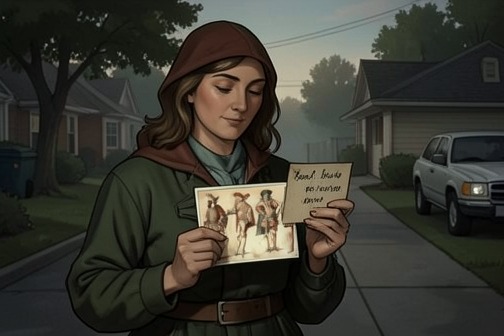
[The threatening photographs sent to Emma](entity:event-recall-event-the-threatening-photogr-d5c5549ece78) Valentine turn ordinary images of [Brian Kagwa](entity:character-recall-character-brian-kagwa-239313e4edf6) into evidence of possible surveillance, then make that evidence vanish. The episode begins with a picture of [Apollo Kagwa and Brian Kagwa](entity:relation-recall-relation-apollo-kagwa-and-bri-df8c5f3544e9) in a driveway, which Emma initially receives from Apollo; it deepens when she describes a later photograph of the baby in a car, taken from outside the window and accompanied by the message GOT HIM. [Apollo Kagwa](entity:character-recall-character-apollo-kagwa-8242cc572315)’s failure to remember the first image, and his insistence that the later texts were never there, leave the threat frightening but unverified. The photographs make a private family’s movements feel exposed while denying Emma a stable record she can show anyone else.
## The driveway photograph
On [Emma Valentine](entity:character-recall-character-emma-valentine-118b416ffa0a)’s second day at work, she opened the [Fort Washington branch](entity:location-recall-location-101efeda2e1e) and tried to settle into the day’s routine. Apollo Kagwa had sent her a burst of photographs. One showed father and son at the driveway of a large home: Apollo Kagwa leaned into a rented minivan, apparently loading or unloading bags, while Brian Kagwa lay on a blanket and looked up at the trees. The picture arrives amid a morning filled with ordinary obligations; a group of daycare children enters the branch before Emma can do more than glance at it, and her work occupies her attention.
The image’s first disturbing feature is not an explicit threat but its composition. Brian Kagwa is on the ground in a driveway while Apollo Kagwa is turned toward the vehicle, a moment Emma later remembers as leaving the baby exposed. Her first reaction is to question why Apollo Kagwa let their son lie there. A second, more unsettling question follows: who took the picture? At home, she searches her phone for ten minutes, trying to confirm what she remembers seeing. The image is absent from her texts, downloads, and photo gallery, as though its sender had retrieved it. The disappearance turns a domestic snapshot into something difficult to distinguish from a warning.
When Emma Valentine confronts Apollo Kagwa, he explains that he had tried to pack the car while wearing Brian Kagwa, but had to lean too far; Brian Kagwa cried, so Apollo Kagwa set him down for a few minutes. Apollo Kagwa is startled when Emma asks about the driveway and asks how she knew. She says he sent her a picture. His response—“I did?”—makes the disagreement immediate: Emma remembers an image from his phone, but he does not remember sending it. The scene supplies no independent confirmation of what happened to the photograph or how it disappeared, so neither explanation settles the question.
## A second image and an explicit warning
A later exchange raises the stakes. Emma Valentine tells Apollo Kagwa that another text arrived the previous night. This photograph showed Apollo Kagwa and Brian Kagwa in a Zipcar, with the baby secured in a car seat; the apparent photographer was outside the passenger window, close enough to make it seem as if someone had crept up beside the child. Unlike the driveway image, this one is accompanied by a direct message: GOT HIM. The wording changes the photograph from an unsettling view of the family into an apparent claim that Brian Kagwa has been located or targeted.
Apollo Kagwa reacts first to the way Emma Valentine refers to the child, shouting that his name is Brian. He drops a pot into the sink, startling the baby, then rushes to pick him up and apologize for the noise. The sharp clang and Apollo Kagwa’s hurried effort to soothe Brian Kagwa place the threatening text beside an immediate, physical act of caregiving. Emma Valentine repeats the message and describes the photograph; Apollo Kagwa asks to see one of the texts on her phone. She says they are gone, adding that they are always gone. The device offers no message for him to inspect, just as the earlier search had produced no driveway image.
## Disputed evidence and unresolved danger
The exchange ends not with proof but with opposing claims. Apollo Kagwa says the messages were never there. Emma Valentine looks toward the microwave clock and turns back to getting ready, rather than resolving the argument. When Apollo Kagwa objects to going to church, he suspects she may have told the priest she wanted an exorcism instead of a baptism. His remark registers how far their disagreement has reached: the threat is entangled with their plans for Brian Kagwa and with their sharply different accounts of what Emma Valentine has seen.
The photographs’ recurrence matters as much as their contents. The first image is attributed to Apollo Kagwa, who cannot remember sending it; the later text depicts the family in a car and carries the words GOT HIM, but disappears before he can inspect it. Emma Valentine’s consistent experience is that the images arrive and then cannot be recovered. Apollo Kagwa’s response is to deny their existence, not to identify a sender or explain their disappearance. The narrative therefore preserves a gap between her perception and his: it does not establish who took the second photograph, who sent the texts, or whether either phone retained the evidence.
That gap makes the missing photographs part of the threat. If the images are real, someone has apparently captured moments around Brian Kagwa and reached Emma Valentine with an alarming message; if Apollo Kagwa is to judge the claim, the evidence is already unavailable. The driveway scene begins with a family picture that could seem harmless until Emma Valentine remembers its circumstances and asks who was behind the camera. The later image sharpens that unease without resolving it. In both cases, the photographs make watching visible for an instant, then leave the family unable to establish exactly who was watching or what happened.
Event 16
Emma seeks chains to secure Brian’s room
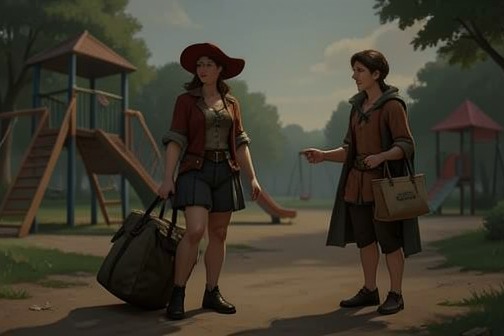
[Emma Valentine](entity:character-recall-character-emma-valentine-118b416ffa0a)’s search for chains to reinforce [Brian Kagwa](entity:character-recall-character-brian-kagwa-239313e4edf6)’s room turns a private fear into a visible, shared task. The errand first looks strange to [Kim Valentine](entity:character-recall-character-kim-valentine-7f8a535a5bd7): Emma carries a heavy bag through the neighborhood and around a playground, unwilling to explain herself. Only after [Kim](entity:character-recall-character-kim-daaac0827eb9) stays beside her does Emma disclose what she hopes the chains will do. The scene’s movement is from alarm and isolation toward practical sisterly support, without suggesting that the chains resolve the fear behind the request.
## The contact and the bag
Emma has heard about a woman through a message board and says the woman was told she would come. When asked who sent her, Emma answers that [Cal](entity:character-recall-character-cal-0d42635ce740) did. The woman opens the door shortly afterward. She appears much younger than Emma and Kim, but shares the exhaustion they associate with new mothers; her skin is sallow and her eyes are red. She passes a large tote through the doorway. Metal shifts and clinks inside. After a brief hope that the contents will be useful, the woman looks quickly at Kim and shuts the door.
Emma heads for the elevator, with Kim close behind. Kim suggests going up to Fort Tryon Park, but Emma refuses. Kim watches her clutch the bag in both hands and struggle with its weight. When Kim reaches for it and asks what is inside, she pulls it away and discovers chains. Emma does not answer the question. She takes the tote back, lifts it with a huff, and, tired of waiting for the elevator, goes for the stairs. The exchange gives Kim a concrete object to worry about, but no explanation yet: the chains are heavy, conspicuous, and plainly important to Emma.
## The route through the playground
Kim follows her sister farther north, reasoning that a thirty-three-year-old woman hauling a bag of chains is not hard to spot. Emma goes into [Jacob Javits Playground](entity:location-recall-location-e9030d5296b6). Kim considers calling [Apollo Kagwa](entity:character-recall-character-apollo-kagwa-8242cc572315), but cannot see how to describe Emma’s behavior without making it sound like an accusation. She loves her brother-in-law, yet she does not want to place herself between him and Emma. Since their parents died, Kim reflects, nobody has truly come between the sisters, and she is reluctant to break that pattern. She briefly tries to explain the chains away as something for new bicycles, remembering that there was also a U-lock in the bag, but cannot quite persuade herself.
The playground’s ordinary activity sharpens the contrast. Mothers push daughters on swings; a couple helps their son climb a jungle gym. An older girl spins herself in a tire swing while her grandmother watches from a nearby bench with a distracted, deeply tired air. Against this background, Emma walks the perimeter as if on sentry duty, carrying the bag. At times it strikes the ground and the chains rattle, an unsettling sound among the children. Kim reaches her, and they walk quietly together. Emma’s tension is so palpable that Kim’s back stiffens and her shoulders lock into a posture like her sister’s. Kim decides not to ask directly about the chains, the woman at the door, or the message board. Instead, she begins telling Emma a story about April 14, 1988, drawing on their shared past to approach what Emma has not yet said.
## What the chains are meant to protect
The explanation arrives when Emma sits upright against Kim’s shoulder and points to the bag. Brian’s room is the one with the fire escape. It already has a security gate, but Emma says that it does not feel like enough. She wants to wrap the chains around it as well. The extra barrier, she admits, would simply make her feel better, and she is afraid Apollo will argue with her rather than agree to install it. The chains are therefore not presented as a measured solution to a demonstrated breach: their immediate purpose is to give Emma some sense of protection when the existing gate cannot reassure her.
Kim meets this admission with closeness rather than challenge. She squeezes Emma and proposes telling Apollo that the chains were ordered by a doctor; she will help put them on. Emma grins and calls her a good sister. Soon the two women rise, each taking one handle, and carry the heavy bag home together. Their shared grip makes the change in the scene tangible: what Emma had hauled alone becomes a burden the sisters carry side by side. Kim’s response does not require her to understand every part of Emma’s fear before offering help.
## Fear, exhaustion, and support
The scene places Emma’s vigilance beside evidence of her exhaustion and distress. Kim understands her sister as worn down: Emma returned to work too soon, and as a baby she lost both parents. Kim connects those circumstances to the possibility that Emma fears losing the person she loves most. Emma has also described a disturbing difference she senses in Brian, though he looks like the child she gave birth to; when she holds him with her eyes closed, she can almost feel that he is someone else. Her fear about the gate belongs to this larger uncertainty, but the scene does not establish that the chains can settle it.
Kim’s loyalty continues beyond the walk home. She suggests that Emma try Zoloft, an antidepressant, and supports her as Emma stops eating and loses six pounds in two weeks. Those later details show how little the act of carrying chains can contain: Emma’s need for protection is entangled with a serious strain that persists after the practical errand. The episode nonetheless marks a real, limited change. Kim does not call Apollo or force Emma to explain herself in the playground; she listens, accepts the stated need, and helps make the proposed safeguard possible. The chains remain a sign of alarm, but they also become the means by which the sisters express care without requiring fear to be argued away.
Event 17
The baptism dispute and Apollo’s awakening restrained
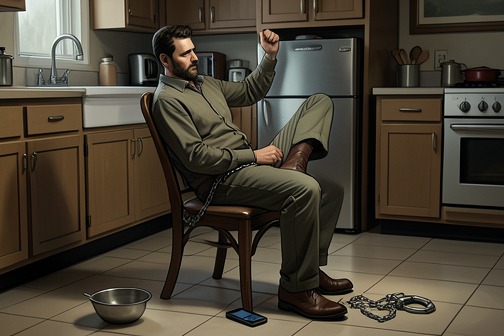
[The baptism dispute and Apollo’s awakening restrained](entity:event-recall-event-the-baptism-dispute-and-6ed4c58e98dd) marks a decisive break in [Apollo Kagwa and Emma Valentine](entity:relation-recall-relation-apollo-kagwa-and-emm-585bbe73e697)’s household: a conversation about baptizing their son [Brian Kagwa](entity:character-recall-character-brian-kagwa-239313e4edf6) turns into an argument about surveillance, mental distress, and who can be trusted to protect the child, before the narrative reveals Apollo chained in his own kitchen. The sequence moves from ordinary childcare to a locked door and then to bodily confinement, making the family’s collapse tangible through familiar objects—a bowl, a phone, a chair, and a bicycle lock.
## The Baptism Becomes a Dispute
Emma raises the baptism while Apollo is at the table with Brian, who bats at a shoe and eats oatmeal from a spoon. She has arranged an appointment for that day, in an hour, at Holyrood Episcopal Church with Father Hagen. The immediate occasion sounds practical, but Apollo is caught off guard: he initially asks whether she means Brian, then learns that his mother has been asking for the baptism since the child’s birth. The short notice turns an established family request into a decision that Apollo feels he has not been included in.
When Emma says she can take Brian alone, Apollo insists that she will not take his son anywhere without him. His response makes the disagreement about more than church or timing. He clears the bowls and handles the oatmeal pot, moving around the kitchen because he needs to get up from the table; routine domestic activity becomes a physical outlet for agitation. The scene’s ordinary parenting details persist even as the adults’ trust in each other deteriorates: Brian accepts his food, and Apollo is still attending to his needs while the argument gathers force.
## Threatening Messages and Broken Communication
Apollo’s question about Emma’s phone in the garbage brings the conflict to its most concrete source. Emma says she received another text the previous night, accompanying a photograph taken through the passenger-side window of a Zipcar. Apollo and Brian were inside; the baby was secured in a car seat, and the car appeared to be stopped at a red light. Emma’s account makes the threat intimate: the unseen photographer came close enough to capture Brian in the back seat. The accompanying message, as Emma reports it, said that the sender had got him.
Apollo’s reply focuses on the way she refers to their son, correcting her in a shout that his name is Brian. He drops the pot into the sink, startling the baby, then rushes to pick him up, apologizes, and holds him tightly. The gesture is protective, but its force is also unsettling: comfort arrives in the same burst of anger that frightened Brian. Apollo demands to see one of the messages on Emma’s phone. She says they are gone, as they always are. The account therefore offers him no visible proof at the moment he demands it, while Emma’s fear remains plainly present.
Emma explains that she wants another person present because she and Apollo are no longer talking to each other. Advice on a message board led her to consider therapy or church, but they cannot afford therapy. Apollo mocks the mothers who offered suggestions and tells Emma that she is the problem, ending with an instruction to take another pill. Instead of treating the baptism as an attempt to bring in support, he reads Emma’s proposal as evidence against her. Their disagreement becomes a closed loop: she seeks an outside presence because conversation between them has failed, and he uses that choice to dismiss her.
## The Door and Apollo’s Promise
Emma leaves the kitchen and returns wearing a coat over her shapeless clothes. Apollo notices how small she has become and feels himself wobble, a moment that registers her visible condition without explaining its cause. She tells him that he does not see, but that he will. When she leaves and slams the door, her keys remain hanging on the wall. Apollo instinctively thinks of giving them to her, then stops himself and locks her out.
That choice changes the practical stakes of their dispute. Emma is outside without the keys she left behind, while Apollo remains inside with Brian. He holds his son up and promises that, whatever happens, Brian is coming with him. The promise sounds like a declaration of protection, but the scene has already shown how Apollo’s protective impulses are entangled with anger and control: he rejects Emma’s solo trip, grips Brian tightly after startling him, and now controls access to their home. The sequence does not settle who is safer or what Emma intends; it leaves the family divided at the threshold.
## Awakening in the Kitchen
The narration then breaks sharply from the argument into Apollo’s confused experience of waking. He hears someone screaming but cannot at first tell whether the voice is his. He imagines himself underwater, sunk and unable to see, with the screams acting like a light that might guide him toward the surface. The image gives his return to consciousness the structure of a struggle through darkness, while the sound of another person’s agony is the only point of orientation.
Apollo tries to move his arms, but they are numb and chained behind him; he has been restrained for hours. Once he opens his eyes, he recognizes his own [New York City](entity:location-recall-location-new-york-city-65df0a129d4c) apartment and kitchen. He is sitting in one of the white IKEA chairs Emma ordered six months earlier, backed into a corner, sweating and covered in still-moist vomit. His feet and shoulders rattle when he moves. A U-lock loops around his throat and holds him to the steam pipe, which is hot because the apartment’s radiators are running. If Apollo leans forward, the lock chokes him; if he slumps backward, his exposed neck touches the pipe and burns. He has to remain exactly upright to avoid both dangers.
The domestic setting has become an apparatus of restraint. The chair bought for the household, the heating system, and the bicycle lock are no longer background furnishings: together they determine whether Apollo can breathe or keep his skin from the hot pipe. The scene ends with him awake but trapped, his arms bound and his movement constrained by the room itself. It does not identify who chained him or explain how he came to be in the chair, so the abrupt transition transforms the preceding promise to protect Brian into an unresolved reversal rather than a completed act of rescue.
## Narrative Significance
The event’s force lies in the contrast between the ordinary and the perilous. A scheduled baptism, a baby’s meal, and a phone discarded in the garbage give way to a threatening photograph, a locked-out spouse, and a man chained by the throat. Apollo and Emma both frame their actions around Brian’s safety, yet their means of protecting him have become incompatible: Emma seeks help outside the couple, while Apollo rejects her account and asserts control over where she may take their son.
The shift into Apollo’s underwater imagery also withholds the transition between the family argument and his restraint. The reader experiences the consequences before learning their cause, sharing Apollo’s limited perception as he follows the scream back to consciousness. Because the narrative leaves the restraining agent and the circumstances unexplained here, the event closes on a double uncertainty: Apollo is physically trapped, and the conflict over whom to believe remains unresolved.
Event 18
Emma Valentine flees Washington Heights
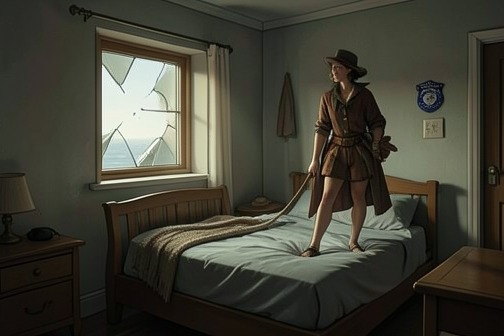
[Emma Valentine flees Washington Heights](entity:event-recall-event-ff61d4f8d9a3) and leaves [Manhattan](entity:location-recall-location-5e470c74b89c) by water taxi, an escape [Apollo Kagwa](entity:character-recall-character-apollo-kagwa-8242cc572315) pieces together from physical evidence and discontinuous surveillance footage. The route ends at [South Street Seaport](entity:location-recall-location-9aaaf984f0e8), where [Kim Valentine](entity:character-recall-character-kim-valentine-7f8a535a5bd7) embraces Emma, presents the passes that allow them to board, and helps her depart. For Apollo, the escape is not only a disappearance but a rupture in his trust: he recognizes the woman beside Emma as [Kim](entity:character-recall-character-kim-daaac0827eb9), whom he had seen in Chinatown that morning and given a ten-thousand-dollar check.
## The Bedroom and the Evidence
When Apollo enters Brian’s bedroom, the police sticker on the door has to be cut through, and the room still bears the marks of the investigation. A board replaces the broken window opening onto the fire escape. The window is a crucial part of Emma’s exit: [Fabian](entity:character-recall-character-fabian-b33e4bae72ab) found the security gate open and the window smashed after seeing the baby but before calling the police. The glass lay on the sill and fire escape rather than inside the room, consistent with someone leaving through the opening.
That evidence establishes a route out, but not a route in. The front door had been locked, Emma had no keys, and no one could explain how she had entered that morning. The police forensic team collected the glass hoping to find blood; blood was present and identified as Emma’s. Its significance is limited but precise: it corroborates her contact with the broken window, without explaining the unexplained entry or resolving how she reached the bedroom.
The room’s damaged window thus gives the flight a material trace while preserving a central uncertainty. The evidence can support the conclusion that Emma escaped by way of the fire escape, but it cannot make her arrival intelligible. That gap matters: the investigation leaves Apollo with signs of Emma’s passage, not a complete account of her movements or means.
## A Route Reconstructed from Fragments
Apollo follows Emma’s path through recordings assembled from multiple cameras. When one camera loses her, another takes over from a different angle farther down the block. The footage is not continuous: at times Emma has left one frame before entering the next, and the cuts were put together by [William Wheeler](entity:character-recall-character-william-wheeler-498c91be32f5) and his many associates. The gaps make the sequence feel less like a seamless record than an incomplete pursuit, as if Apollo were following Emma through the city in the present. Only the timestamps insist that the images are old.
The footage carries her from downtown [New York City](entity:location-recall-location-new-york-city-65df0a129d4c) toward open water. Apollo recognizes South Street Seaport and Pier 16, where the New York Water Taxi runs. The destination is personally charged: it was the site of the last date night when Apollo and Emma were a happy couple, and Apollo had taken her there. That familiar memory gives him a possible explanation for her choice of pier and for her knowledge that a late-night departure was available. It does not establish when she planned the escape, or how she obtained the means to make it.
Apollo measures the practical threshold of departure as thirty dollars for an access pass: a small price set against the consequence of vanishing from Manhattan. The contrast makes the escape seem both startlingly accessible and emotionally immense. Yet the footage does not show Emma arranging every part of it. It shows her waiting among tourists and young adults in a crowd, at the point where the route out of the city is about to become visible.
## Kim’s Intervention
A woman emerges from the crowd and walks directly to Emma, putting her arms around her. Emma remains stiff during the embrace. When the water taxi arrives, the woman lets go, leads Emma to the end of the long line, and waits with her until they reach the boat. She displays two passes, and the pair board together. The recording makes the assistance concrete: Kim is not merely present at the pier but supplies the passes and accompanies Emma onto the taxi.
Apollo recognizes Kim. He had been with her in Chinatown that same morning and had given her a check for ten thousand dollars. The footage does not explain whether that money paid for the passes or what Kim intended to do with the check; it establishes the stark proximity between Apollo’s recent act of financial trust and Kim’s role in Emma’s departure. The embrace is also not evidence of easy reconciliation: Emma’s stiffness remains visible even as Kim helps her leave.
[Patrice Green](entity:character-recall-character-patrice-green-5a8152029152) and [Dana Green](entity:character-recall-character-dana-green-55e891b3bfbf) recognize Kim as well. Neither looks at Apollo; both lower their heads. Their reaction does not explain what they knew beforehand, but it marks the discovery as painful in the room where the footage is being watched. Apollo sees the water taxi pull away, and the image joins Emma’s disappearance to his recognition of the person who facilitated it. He then takes out his phone and texts William Wheeler.
## Consequences and Narrative Significance
The flight is disclosed in two kinds of evidence: the broken window and blood locate Emma’s passage from the bedroom, while the camera recordings trace her to a boat leaving Manhattan. Neither offers an uninterrupted account. The forensic findings corroborate contact with the window but leave her entry unexplained; the surveillance edits show successive glimpses but leave gaps between them. The escape is therefore reconstructed rather than fully witnessed, and Apollo’s understanding arrives through fragments that answer some questions while sharpening others.
The scene’s decisive reversal is relational. Apollo follows the footage expecting to learn where Emma went; instead, he discovers that Kim helped her go. The last date-night location makes the pier a remnant of Apollo and Emma’s former intimacy, while Kim’s passes turn that shared geography into an exit. Emma’s departure becomes a separation from Manhattan and, in the act of watching, a new separation between Apollo and the people beside him. The water taxi’s departure confirms that the escape has succeeded; Apollo’s recognition of Kim gives that success its immediate personal cost.
Event 19
Nils Knudsen brings the troll to Queens
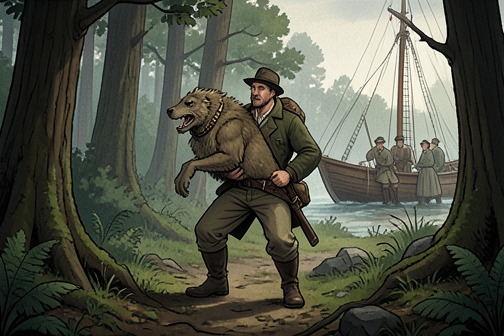
[Nils Knudsen](entity:character-recall-character-nils-knudsen-03001c77f3f6)’s move from Norway to [Queens](entity:location-recall-location-queens-6c6ea4959925) brought a creature of the natural world into a changing American landscape—and bound his family to a bargain paid for with a child. In [Jorgen Knudsen](entity:character-recall-character-jorgen-knudsen-4e40f4294af2)’s account, the troll’s arrival begins as a desperate form of insurance and ends with [Nils](entity:character-recall-character-nils-543bb1df6b2d) carrying out the creature’s demand for Agnes.
## Causes and the Crossing
Nils needed to leave Norway with his wife, [Anna Sofie](entity:character-recall-character-anna-sofie-d61d73ae1756), and did not want to begin a new life without her. But when he saw the small sloop that the Quakers planned to sail, he doubted it could safely carry his family. He brought the troll as insurance against that uncertainty, though the protection came at a price.
The [Sloopers](entity:organization-recall-organization-sloopers-a627a4e49960) reached New York and went upstate; Nils, Anna Sofie, and [Petra Mikkelsdatter](entity:character-recall-character-petra-mikkelsdatter-28245210bc67) remained in Queens. The move therefore split the Knudsens’ course from that of the other passengers and placed the family in a landscape where the creature could remain close at hand.
## A Creature in Queens
In Norway, Jorgen explains, such beings belonged to the natural world, making their lairs in forests and mountains. Queens, before the park existed, offered a comparable expanse: farmland and thousands of acres of forest and green land. Jorgen names the creature Jotunn and Trolde in Norwegian, situating it within the family’s homeland rather than treating its presence as an unfamiliar intrusion into nature.
The landscape changed around it. By [1898](entity:time-recall-time-1898-4f102f8403e9), land for the park had been purchased and its design was beginning, with golf courses and hiking paths planned across hilly country. The development did not eliminate the terrain’s hidden spaces: pockets and caves remained places where something large could conceal itself. The account thus connects the troll’s survival not to a static wilderness but to pockets of older terrain persisting within a designed park.
## The Bargain and Agnes
Nils’s responsibility did not end with bringing the troll across the ocean. Under the deal he had struck in Norway, he became its caretaker, charged with keeping it appeased. Its demand was a child. When he could no longer delay, Nils took his daughter Agnes into the woods and delivered her to the creature’s cave.
The arrival therefore established a continuing obligation rather than a single act of protection. The family’s passage to a new life was secured, in Jorgen’s telling, through a bargain that made a child the price of appeasement. Nils’s decision to carry the troll to Queens and his later delivery of Agnes are linked stages of the same pact.
Event 20
Agnes Knudsdatter is abandoned in the cave
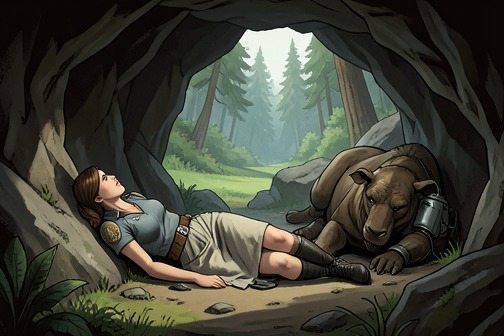
[Agnes Knudsdatter](entity:character-recall-character-agnes-knudsdatter-075bc4e92f72) is abandoned in a cave by her father, [Nils Knudsen](entity:character-recall-character-nils-knudsen-03001c77f3f6), to satisfy a bargain with a troll. Recounted by [Jorgen Knudsen](entity:character-recall-character-jorgen-knudsen-4e40f4294af2) to [Apollo Kagwa](entity:character-recall-character-apollo-kagwa-8242cc572315), the event turns an inherited family pact into a specific act of parental betrayal, while the landscape around [Queens borough](entity:location-recall-location-d351579d9a78) supplies the hiding places that let the bargain endure.
## Causes and Setting
Jorgen places the sacrifice within [Nils](entity:character-recall-character-nils-543bb1df6b2d)’s migration from Norway. Nils wanted to bring his wife, [Anna Sofie](entity:character-recall-character-anna-sofie-d61d73ae1756), with him, but doubted that the small sloop planned by the Quaker migrants would safely carry his family. He brought the troll as what Jorgen calls insurance, at a price: Nils would serve as its caretaker and appease it. The arrangement followed the family across the ocean rather than ending with the journey.
Nils, Anna Sofie, and [Petra Mikkelsdatter](entity:character-recall-character-petra-mikkelsdatter-28245210bc67) remained in Queens borough while the other [Sloopers](entity:organization-recall-organization-sloopers-a627a4e49960) traveled farther upstate. At first the area was farmland, with thousands of acres of forest and green space. Jorgen explains that such terrain resembled the troll’s natural habitat, and that the later park’s hills and pockets still held caves where something large could hide. He also frames the land on a much longer timescale: the Laurentide ice sheet once covered the region beneath ice a thousand feet thick. The city’s apparently settled ground thus carries traces of geological change as well as the older, wooded landscape in which the family’s bargain took root.
## The Abandonment
The pact demanded a child. When Nils could no longer delay fulfilling it, he took his daughter Agnes into the woods and delivered her to the creature’s cave. Jorgen’s account makes the act deliberate: Nils was not separated from Agnes by accident or by the journey from Norway, but acted as the troll’s caretaker by handing over his own child.
The story is told retrospectively, as Jorgen explains the family’s past to Apollo. Its immediate force comes from the collision between an abstract account of migration and the concrete consequence of the bargain: a father carries his daughter into the woods and leaves her in a cave. Apollo’s attention shifts from Jorgen’s explanation to a sketch of the abandoned baby, and he looks away, overwhelmed by what the account entails.
## Consequences and Uncertainty
The sacrifice also helps explain the family’s recurring history of children given to the troll. In Jorgen’s den, a sequence of portraits runs along the wall like a timeline: sketches and charcoal drawings give way to daguerreotypes, black-and-white photographs, and early color images. Every subject is an infant, and none is older than a year. The images turn the story of Agnes from an isolated atrocity into part of a pattern preserved across generations.
Jorgen says the bargain was difficult because asking a mother to surrender her child proved unbearable for Anna Sofie. She broke down, went into the woods to look for Agnes, and never came out. Apollo suggests that she might have found her daughter and fled, but Jorgen refuses to confirm that hopeful possibility. The account leaves both women’s fates unresolved: Agnes is known to have been abandoned, while Anna Sofie disappears searching for her.
## Narrative Significance
The episode reveals that the Knudsen family’s apparent connection to the troll rests on an inherited arrangement maintained through the sacrifice of children. Jorgen presents the bargain as practical insurance against a dangerous crossing, but its cost exposes the violence concealed inside that language of protection. The cave is both a real hiding place in a landscape of forests and hills and the point at which family history becomes an act of abandonment. By placing Agnes’s story beside the succession of infant portraits, the narrative makes the past not a single tale told once, but a repetition whose consequences remain visible to Apollo.
Event 21
Anna Sofie disappears in the woods
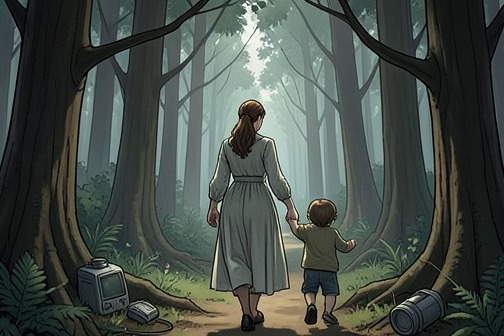
[Anna Sofie disappears in the woods](entity:event-recall-event-anna-sofie-disappears-i-18adf606f72c) after setting out to look for her daughter, [Agnes Knudsdatter](entity:character-recall-character-agnes-knudsdatter-075bc4e92f72). Recounted by [Jorgen Knudsen](entity:character-recall-character-jorgen-knudsen-4e40f4294af2) to [Apollo Kagwa](entity:character-recall-character-apollo-kagwa-8242cc572315), the event is a family history shaped by a stark absence: [Anna Sofie](entity:character-recall-character-anna-sofie-d61d73ae1756) went into the woods and never came back, while what she found there remains uncertain.
## Background and Disappearance
Jorgen links Anna Sofie’s disappearance to the difficulty [Nils](entity:character-recall-character-nils-543bb1df6b2d) faced in asking a mother to hand over her own child. Anna Sofie, he says, broke under the strain and vanished into the woods to search for Agnes. His account establishes the search and her failure to return, but does not say whether she found her daughter.
## Apollo’s Theory and Jorgen’s Response
Apollo proposes that Anna Sofie found Agnes and fled because her husband could not be trusted. Jorgen answers with a thin smile: “Isn’t it pretty to think so?” The response refuses to confirm Apollo’s hopeful reconstruction. Anna Sofie’s disappearance remains unresolved, and the possibility that she escaped with Agnes belongs to Apollo’s conjecture, not to any established account of what happened.
## Place in the Recounted History
Jorgen tells the story while giving Apollo what the narration presents as a kind of education in a horrific history. The account turns Anna Sofie’s absence into part of that history without making her fate knowable: Apollo’s imagined escape offers a possibility, but Jorgen’s reply leaves the search’s outcome open.
Event 22
Kinder Garten sacrifices his daughter Agnes
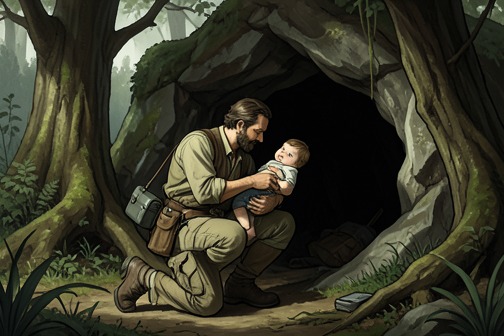
[Kinder Garten sacrifices his daughter Agnes](entity:event-recall-event-kinder-garten-sacrifice-5f7f7861706a) when [Jorgen Knudsen](entity:character-recall-character-jorgen-knudsen-4e40f4294af2)’s son leaves [Agnes Knudsdatter](entity:character-recall-character-agnes-knudsdatter-075bc4e92f72) in a cave in the forest to honor the Knudsen family’s pact with the troll. Recounted by Jorgen, the abandonment is presented not as an isolated act of violence but as an attempted restoration of an inherited tradition, followed by the rupture of the son’s family and his collapse.
## Background: A Pact Recast as Heritage
Jorgen describes his son as believing that the troll was not a burden on the family but a blessing. In his son’s view, the family had gone wrong when [Nils Knudsen](entity:character-recall-character-nils-knudsen-03001c77f3f6) refused to sacrifice one of [Petra Mikkelsdatter](entity:character-recall-character-petra-mikkelsdatter-28245210bc67)’s children. The troll had brought the family to these shores, he believed, and its power could secure their deliverance again. He understood that possibility as a right and an inheritance, and concluded that the family must return wholeheartedly to its origins.
## The Abandonment
Acting on that conviction, Jorgen’s son undertook to honor the pact as he believed it was meant to be honored. Jorgen compares his action to Nils Knudsen’s choice nearly one hundred and ninety years earlier: his son left Agnes Knudsdatter in a forest cave. Jorgen says he admired his son’s fortitude, a judgment that exposes the family’s inherited code from within. The act could be understood as sacrifice in service of tradition, even as its immediate human consequence was a child abandoned in a cave.
## Family Rupture and Aftermath
Jorgen says that his son’s wife could not accept his vision or admire what he regarded as courage. She left him and took [Grace Wheeler](entity:character-recall-character-grace-wheeler-1b0ba1d59efb) with her. Jorgen frames the separation as the blow that broke his son: he says his son loved his wife and daughters so deeply that he would sacrifice his own child for them, yet the sacrifice did not preserve his household. Instead, Jorgen says, his son lost his mind, and Jorgen had been caring for him ever since.
The account connects the old pact to a present family’s disintegration. What the son treated as ancestral duty and a route to collective deliverance became an act that separated him from his wife and one daughter, while Agnes was left behind. Jorgen’s admiration for his son’s resolve makes the episode’s inheritance especially stark: the tradition survives through repetition, but its cost falls on the children and the family it was supposed to protect.
Event 23
Jorgen Knudsen confesses the family pact
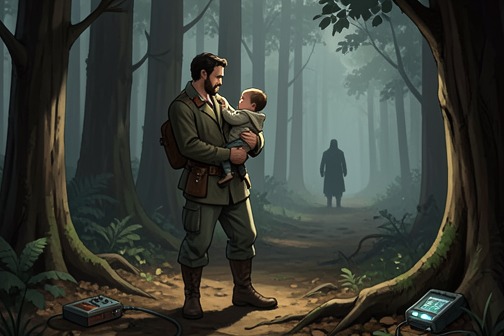
[Jorgen Knudsen](entity:character-recall-character-jorgen-knudsen-4e40f4294af2)’s confession reveals the Knudsen family’s generations-long pact with a [Troll](entity:creature-recall-creature-troll-ea2ad2ac47a6): the creature offered protection, and the family supplied children. His account links a Norwegian immigrant’s desperate bargain to a history of abandoned babies in [Queens](entity:location-recall-location-queens-6c6ea4959925), then exposes the confession itself as a father’s deliberate sacrifice of time so his son can flee. The family’s story is not merely a secret about a monster; it is a defense of inherited violence, and it ends with Apollo killing Jorgen.
## The pact’s origins and setting
Jorgen explains that [Nils Knudsen](entity:character-recall-character-nils-knudsen-03001c77f3f6) brought the creature from Norway when he left with his wife. The Quakers’ planned sloop seemed too small to [Nils](entity:character-recall-character-nils-543bb1df6b2d), who feared for his family’s safety, so he secured what Jorgen calls insurance. That protection came at a price. The [Sloopers](entity:organization-recall-organization-sloopers-a627a4e49960) continued upstate after reaching New York, while Nils, [Anna Sofie](entity:character-recall-character-anna-sofie-d61d73ae1756), and [Petra Mikkelsdatter](entity:character-recall-character-petra-mikkelsdatter-28245210bc67) remained in Queens, which Jorgen describes as farmland rather than a park: thousands of acres of forest and green country.
The setting made the bargain possible. In Jorgen’s account, such creatures belong to the natural world and make lairs in forests and mountains. Queens offered the same cover, with hills, pockets, and caves where something enormous could remain hidden. He places the park’s development in [1898](entity:time-recall-time-1898-4f102f8403e9), when the land was bought and plans for golf courses and hiking paths began. The city’s designed landscape, in this telling, never entirely erased the older terrain beneath it. Jorgen gives the creature Norwegian names, Jotunn and Trolde, placing the family’s American history inside an older folklore and a landscape that still accommodates its lair.
## Children as the price of protection
The original agreement made Nils the creature’s caretaker, responsible for appeasing it. Jorgen says the Troll demanded one thing: a child. When Nils could postpone the payment no longer, he took his daughter Agnes into the woods and delivered her to the cave. The confession gives the pact a specific human cost: a father’s decision to abandon his own child, carried out not in a distant past but in a place that would become part of Queens.
Jorgen’s account broadens from Agnes to the accumulated record on the den’s walls. The portraits run in a timeline from sketches and charcoal renderings through daguerreotypes, black-and-white photographs, and early grainy color images. Every pictured child is an infant, none older than a year. Apollo recognizes the scale of the collection as a sea of small faces, and the range of the victims’ complexions makes the history one of immigrant children across Queens, not simply the family’s own descendants. The images turn Jorgen’s inherited story into visible evidence of repeated loss.
Jorgen resists Apollo’s description of the children as food. He insists that the creature tries to raise them, presenting its attempted parenthood as a distinction between sacrifice and killing. That distinction does not undo the abandonment: the children were still taken from their families and delivered to the cave. Jorgen also says Nils did not repeat the sacrifice within his later household. Nils quickly married Petra and had seven children with her, but did not take them into the woods again. Jorgen attributes this both to the lesson Nils had learned and, as a belief rather than a certainty, to the possibility that the sacrifice had been too painful to repeat. He remembers the seven children’s stories of Nils’s kindness, setting personal tenderness beside the violence on which the family’s protection depended.
## A renewed bargain and its targets
The pact did not end with Nils. Jorgen says his son came to believe the Troll was not a burden but a blessing, and that the family had to restore its old traditions. In his son’s interpretation, the family’s fortunes had gone wrong when Nils refused to sacrifice one of Petra’s children; the creature’s power could now deliver the family again. Jorgen describes this belief as a claim of right and heritage, joining the pact to his son’s sense of lost status and an imagined earlier promise of white men’s economic advancement.
Jorgen then identifies the consequence: his son renewed the pact as Nils had done, leaving his own daughter Agnes in a forest cave. [Gretta Wheeler](entity:character-recall-character-gretta-wheeler-ab86e4ffac0f) could not accept this act. She left her husband and took [Grace Wheeler](entity:character-recall-character-grace-wheeler-1b0ba1d59efb) with her; Jorgen says the separation broke his son and that he has cared for him since. The repetition is especially stark because the earlier history, which Jorgen presents as a precedent, has become a pattern within the next generation. What the family calls tradition requires another child to bear its cost.
The victims were not limited to Knudsen descendants. Asked how the children were selected, Jorgen describes searching for hours or days while in service and, during the 1980s, driving everywhere in a white van. He says he sought a boy or girl without protection: a baby no one was watching, someone treated as a castoff. He claims he learned to recognize such candidates immediately. His earlier justification—that Queens had many immigrants and immigrants had many children—reveals how the pact’s supposed family necessity depended on the vulnerability of other families. His language of hard choices and national prosperity attempts to dignify a practice whose targets were children without anyone able to protect them.
## Confession as a father’s diversion
Jorgen’s account appears to disclose family history, but its immediate purpose is also tactical. He reveals that the open front door and the light left on were signals for his son to run. What Apollo took for an old man unburdening himself was, Jorgen explains, a way to give his son time to escape. His invocation of what a good father would do therefore has two meanings: it echoes the paternal justification behind the pact, while describing a present act of protection for his son, even after that son has repeated the family’s violence.
The confession becomes a confrontation. Apollo approaches Jorgen with the utility knife; Jorgen asks him to give it over, and Apollo kneels as if granting the request before thrusting the blade into Jorgen’s neck. The disclosure thus ends not in reconciliation or a negotiated reckoning but in Jorgen’s death. Apollo is blinded and spattered by the blood, an immediate physical consequence that follows the revelation of a long history of harm. The scene’s reversal is complete: the family account that explains the monster’s claim on children also exposes the human choices sustaining it, while Jorgen’s final paternal act helps the son who renewed that claim escape.
Event 24
Apollo kills Jorgen Knudsen
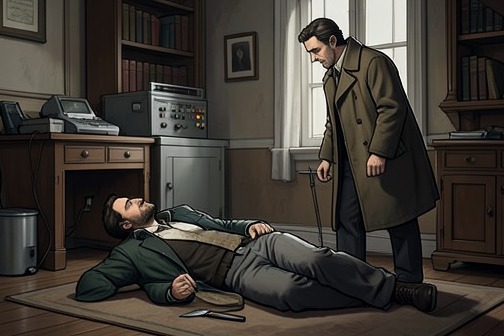
[Apollo kills Jorgen Knudsen](entity:event-recall-event-apollo-kills-jorgen-knu-72b2c0325d16) after learning that the old man’s apparent confession was a deliberate diversion intended to give [Kinder Garten](entity:character-recall-character-kinder-garten-594d97ed2061) time to flee. The murder follows a reversal of trust: Jorgen’s story explains his family’s past, but its real purpose is to protect his son in the present. Afterward, Apollo leaves with the cooked sheep’s head Jorgen had been preparing, uncertain whether it can serve as an offering to [Emma Valentine](entity:character-recall-character-emma-valentine-118b416ffa0a) and whether Kinder Garten has escaped.
## The confession as a diversion
Jorgen’s account of his family history is also an explanation of the anguish and instability he attributes to his son. He says that [Gretta Wheeler](entity:character-recall-character-gretta-wheeler-ab86e4ffac0f) left him and took [Grace Wheeler](entity:character-recall-character-grace-wheeler-1b0ba1d59efb) with her after rejecting his vision and courage. In Jorgen’s telling, his willingness to sacrifice his own child had broken his wife’s trust, and the loss had helped drive Kinder Garten out of his mind. Jorgen presents himself as the person who has cared for his son ever since. The history makes his devotion legible, but it does not make his account disinterested.
The open front door and the light left on are not signs of welcome for Apollo. Jorgen reveals that they are a signal Kinder Garten understands as an instruction to run. The disclosure changes the meaning of the preceding conversation: Jorgen has not simply unburdened himself but has used Apollo’s attention to buy his son time. His explanation that he was doing what a good father would do frames the deception as an act of parental protection. It also exposes the conflict at the heart of the scene: Apollo has been listening to the past while Kinder Garten may be escaping in the present.
## Apollo kills Jorgen
Once Jorgen asks for the blade, Apollo goes down on one knee and appears to give it to him. Instead, he uses it to kill Jorgen. The movement makes the exchange a reversal rather than a surrender: Apollo’s gesture of compliance becomes the means by which he acts against the man who has just admitted to deceiving him. Jorgen’s attempt to direct the blade toward himself does not avert the killing.
The kitchen timer sounds during the struggle, abruptly setting an ordinary household task beside the murder. Its alarm continues after Jorgen has fallen, and Apollo turns off the high flame beneath the pot. The timer and the cooking do not interrupt the consequences of the killing; they draw Apollo back to the practical scene around him. He recognizes that Jorgen is dead, then returns to the meal that had been in progress. The episode thus moves from family history and calculated delay to immediate violence, and then to the stubborn continuation of domestic routine.
## The meal and the departure
Apollo leaves 124 86th Road under cover of night carrying a covered serving plate with the cooked sheep’s head. The potatoes and cabbage have boiled for three hours and are ruined; the water in both pots has boiled away, leaving what remains scorched. The sheep’s head, by contrast, has stayed whole through the cooking. These details mark the cost of the time spent in the house: the meal has been prepared, but the rest of it is lost while the confrontation unfolds.
Jorgen had told Apollo that he brought meals to Emma Valentine, sometimes Starbucks and sometimes food he had made, as a kind of offering. Apollo wonders whether he must do the same and whether the sheep’s head will be enough. His questions leave the gesture unresolved: he carries the food without knowing whether he has learned the steps that would make it meaningful. He also wonders whether Kinder Garten came to the front door, saw Jorgen’s signal, and escaped while Apollo was occupied in the windowless den. The possibility is Apollo’s inference, not a confirmed account of Kinder Garten’s movements.
## Consequences and significance
Jorgen’s death does not resolve the danger that brought Apollo to the house. The old man’s signal may have succeeded, and Apollo leaves without knowing whether Kinder Garten is still nearby. The murder instead converts the deception into a lasting practical uncertainty: Apollo has stopped Jorgen from directing the encounter, but he may have lost the time needed to learn what comes next. His departure with the meal makes that uncertainty concrete. The cooked sheep’s head is at once the surviving product of Jorgen’s domestic labor and an object Apollo carries forward without knowing whether it can fulfill the purpose Jorgen described.
The scene gives Jorgen’s appeal to fatherhood a double consequence. His effort to protect his son leads him to manipulate Apollo, and that manipulation provokes Apollo’s fatal response. The phrase of paternal duty is therefore not simply an excuse or a moral resolution; it names the principle Jorgen uses to justify a deception whose consequences neither man controls. Apollo kills him, yet does not emerge with certainty or closure. He leaves the house at night with a possible offering, a ruined meal behind him, and the possibility that the person he came to confront has already escaped.
Event 25
Lillian reveals Brian West tried to kill Apollo
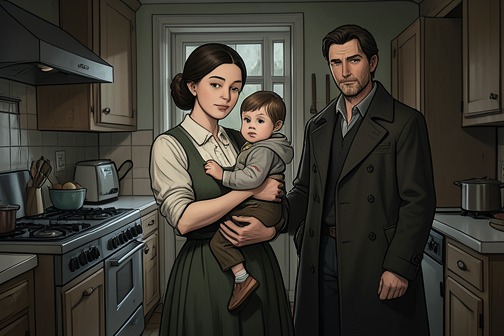
[Lillian](entity:character-recall-character-lillian-2f0105dc3d76) reveals that [Brian West](entity:character-recall-character-brian-west-52d0ec5f8775) tried to kill [Apollo Kagwa](entity:character-recall-character-apollo-kagwa-8242cc572315) when Apollo was a child, changing the meaning of his father’s love, his mother’s silence, and the storybook Brian had kept. In her account, Brian’s fear of losing his family did not prevent him from trying to kill Apollo; it was bound up with the crisis that led him to do so. The revelation resists a simple division between a loving father and a dangerous one: Lillian insists both descriptions are true.
## The Story and Its Frame
The disclosure comes as Lillian is reconsidering how she has described the past. She explains that another person’s account of an old encounter had become more flattering to him over repeated tellings, until he seemed to believe his own version. That recognition leads her to wonder whether her silence about Apollo’s father had similarly protected a preferred story, for herself as well as for Brian. Her admission makes the scene more than a belated report of violence: it is also an effort to examine how memory and omission can shape a family’s account of itself.
Apollo presses her to tell him what happened. He is standing in [Jorgen Knudsen](entity:character-recall-character-jorgen-knudsen-4e40f4294af2)’s kitchen, where the man Apollo killed lies dead; unwilling to hear his mother’s story while facing that body, Apollo stops pacing and braces himself against the door to the den. The present scene therefore places a revelation about one father’s attempted violence beside the immediate fact of a son’s own killing. Lillian is the narrator of the remembered incident, while the novel presents her account as a disclosure to Apollo rather than as an independently staged scene from the past.
## Lillian’s Account of the Bathtub Incident
Lillian says she returned from work at one o’clock with McDonald’s for herself and Apollo. She had felt guilty and knew he liked the French fries. The unlocked front door struck her as strange; when she heard the bath running, she feared Apollo might have got into trouble in the water. She dropped what she was carrying and hurried to the bathroom. There, she says, she found Brian attempting to drown their son in the tub.
Lillian falters before naming what she saw, and Apollo asks her to continue even though he is not sure he wants to hear it. She tells him that Brian had removed his clothes and was holding him under the water. She confirms that the water was hot. Apollo’s hand slips, and he slides down to the floor. The revelation turns an uncertain childhood memory into a specific account of a deliberate attempt on his life, delivered by the person who arrived and witnessed it.
Lillian says Brian also intended to kill her and then himself. She connects that plan to her decision to leave: she had served Brian with divorce papers and planned to take Apollo with her. In her telling, the attempt was not an isolated act detached from their marriage; it occurred at the point when Brian faced the loss of the family he had wanted to possess and preserve.
## Brian’s Fear and the Storybook
Asked why Brian acted as he did, Lillian describes the childhood he had told her about: his parents had treated him badly, and he had longed for a family of his own. From the age of twelve, he had been telling himself stories about what that family would be. Lillian says that even as an adult he remained attached to a child’s understanding of how life should unfold; he could not change or adapt when the marriage was ending. This account supplies context for his terror of losing Apollo, but it does not excuse the attempt to kill him.
Apollo thinks of the objects in the box, including the book. Lillian explains that Brian had lived in fear of losing his son and saw his own childhood through the story of a child taken by goblins and left without anyone to rescue him. Brian had not had an Ida who could come for him. He kept the book and wanted to read it to Apollo because he imagined himself coming to save his son. The storybook thus joins Brian’s fear and his desire to act as a rescuer, while the bathtub revelation exposes the violence concealed within that self-image.
## Consequences and Significance
Lillian’s account leaves Apollo with two truths that cannot be reconciled by choosing one and discarding the other: Brian loved him, and Brian tried to take his life. Her insistence on holding both together corrects any account in which the book or the father’s devotion alone defines their relationship. Love explains what Brian feared losing and what he imagined himself doing; it does not erase what Lillian says he did.
The scene also makes Lillian’s silence part of the family history under examination. Having recognized how someone can settle into a self-serving version of the past, she wonders whether withholding the truth about Brian had allowed a similarly protective account to stand. Telling Apollo does not undo the event or resolve his response. Instead, it gives him a new and devastating account of his father, while making the book’s rescue story newly ambiguous: Brian wanted to be the one who came for Apollo, yet Lillian says that he was also the person from whom Apollo needed saving.
Event 26
Apollo and Emma reunite at the cave
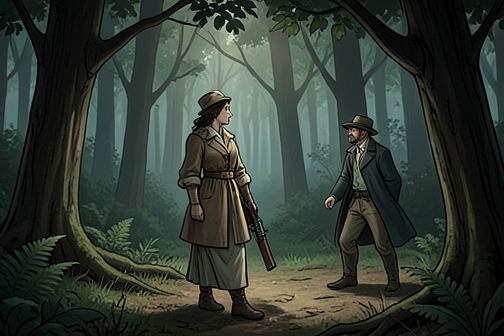
[Apollo Kagwa and Emma Valentine](entity:relation-recall-relation-apollo-kagwa-and-emm-585bbe73e697) reunite at the cave after Apollo follows her into the Northern Forest. The meeting is at once supernatural revelation and intimate reckoning: Apollo finally acknowledges that Emma had seen the truth, while the storm around her gives way to a woman worn down by guarding [Brian Kagwa](entity:character-recall-character-brian-kagwa-239313e4edf6) without sleep. Their reunion does not erase the harm between them, but it opens a fragile possibility of care.
## The witch in the forest
Apollo enters the woods after hearing what seems at first to be running water, only to realize that the sound is words whispering all around him. He has entered the woods of a witch and made an offering; then, as the narration puts it, the witch appears. The scene frames the reunion not as an ordinary encounter between spouses but as entry into a world whose reality Apollo has resisted.
He sees Emma at the center of blue light and rippling clouds of cobalt smoke. A freezing wind pulls at his coat, his ears ring, the air smells burned, and lightning dazzles his eyes. Emma appears to wear the weather like a cloak. As she moves toward a staircase landing, trees part before her without her raising a hand. A covered serving plate rises into the air and settles on her outstretched hand. The objects and gestures make her power visible: the forest responds to her, and the food she carries seems subject to the same force.
Words from the children’s book play on Emma’s lips and echo across the dirt, tree limbs, concrete staircase, and night sky. Apollo follows her blue light along a forest path that grows less distinct as it climbs through trees and gives way to grass, moss, and fungi. The setting deepens the separation between the familiar world and the place he has entered, but the encounter’s decisive movement comes when he speaks to Emma rather than merely witnessing her.
## Recognition and the fading storm
As Emma reaches the top of a sharp slope, Apollo calls out, “You were right all along, Emma.” She gives no response. He then names the truth he had failed to accept: “It wasn’t a baby.” When he adds, “The goblins were real!” Emma turns toward him for the first time. Her eyes seem so dark that she looks blinded, and the whole Northern Forest rises into a shout around them.
The admission marks a reversal in their encounter. Apollo had approached Emma through a spectacle he could scarcely comprehend; now he gives voice to the reality she had been trying to make him see. As he recognizes the goblins, the cloud of energy around her parts. The terrible weather falls away, revealing a thin woman in a ragged maroon puffer coat, holding a pewter serving tray. Apollo sees cracked lips and puffy, yellowing eyes. The forest falls silent, and the revelation of Emma’s power is immediately followed by a view of its human cost: she is not only a witch-like presence at the center of a storm but a visibly depleted person.
## The watch over Brian
At the cave, Apollo asks when Emma last rested and where she sleeps. She is picking meat from the eye socket of a cooked sheep’s head when he touches the back of her hand; she drops the meat and draws her hand into her lap. She tells him, “I never sleep,” and explains that she keeps watch through the night so Brian Kagwa will stay safe. The admission gives her presence at the cave a practical purpose: the watch is not a display of power but a sustained act of protection.
Emma also recalls that, when she was eight months pregnant, a smiling stranger stopped her in the street and told her that motherhood would mean never again having a life without stress or a good night’s rest. Emma remembers wanting to scratch the woman’s eyes out, angered by the way she seemed to treat anxiety as a badge of honor. The memory connects her present sleeplessness to an earlier warning, but the scene does not make that burden sound effortless or noble. Emma’s guardedness, her exhausted appearance, and her watch over the cave show the cost of remaining alert.
Apollo wants to hold her and let her rest. He tells her, “You could rest tonight,” and offers to stay awake. Emma looks from him to the cave and touches the sheep’s head without picking at it; her finger trembles as she asks if he is sure. Her hesitation makes the offer consequential: accepting care would mean trusting Apollo with the vigil she has kept alone. She does not immediately set aside the distance between them, but she does test whether he will remain present.
## A tentative return to care
Emma directs Apollo to go down and look at the stones when he is ready. The instruction remains distinct from his offer to keep watch: even amid the reunion, she gives him something he must choose to see for himself. Then her puffer coat seems to deflate around her as she draws its arms across her belly, lowers her head, and covers her face with the hood. The change is small and bodily, a sharp contrast to the storm and the trees that had obeyed her moments before.
Later, when Apollo says that he wants her to come with him in the morning to a nearby house where no one can bother them, Emma does not answer or lean into his touch. She also does not shrug his hand away when he places it lightly at the small of her back. They remain together until dawn. The reunion therefore ends not with a declaration that their past is repaired, but with a limited, observable change: Emma allows Apollo’s hand to stay, and the two sit beside one another through the night.
## Significance
The encounter binds supernatural recognition to the work of caregiving. Apollo’s admission that Emma was right changes the terms of their reunion; his offer to take the watch gives that recognition a practical form. Yet Emma’s silence, trembling finger, and failure to show relief prevent the scene from turning reconciliation into an easy resolution. The cave remains the place where Brian Kagwa must be protected, and Emma’s vigilance remains a fact of the moment. What changes is that Apollo is present with her, offering to share the night rather than merely interpret the storm.
Event 27
Brian Kagwa is confined in the troll’s cave

[Brian Kagwa](entity:character-recall-character-brian-kagwa-239313e4edf6)’s confinement in the [Troll](entity:creature-recall-creature-troll-ea2ad2ac47a6)’s Cave is revealed as both a rescue discovery and a new danger: [Kinder Garten](entity:character-recall-character-kinder-garten-594d97ed2061) proves that Brian is alive, but the hidden camera and the child’s concealed shelter lead [Apollo Kagwa and Emma Valentine](entity:relation-recall-relation-apollo-kagwa-and-emm-585bbe73e697) into the presence of the creature sharing the cave. The sequence turns a claim made at a computer into a physical encounter, and makes the recovery of Brian inseparable from the threat surrounding him.
## The promise and the surveillance
During the confrontation in [Jorgen Knudsen](entity:character-recall-character-jorgen-knudsen-4e40f4294af2)’s basement, Kinder Garten insists that Brian is alive and offers to show Apollo and Emma how he knows. The assurance changes the immediate stakes: Brian is no longer only the child Kinder Garten has taken from them, but someone they may still be able to reach. Kinder Garten directs them to the computer rather than explaining the child’s condition in person, placing technology between the parents and the evidence they need.
The screen initially gives them little to see. Kinder Garten activates what he calls subject zero, while Apollo answers by naming the child Brian. A numerical counter appears against a black screen; Kinder Garten then moves the camera until the image resolves into packed earth and stone. Apollo recognizes the location as the cave and understands that Kinder Garten has installed a camera there. The revelation gives the family’s separation a material mechanism: Brian is hidden underground, but his location has been made visible to Kinder Garten through remote observation.
That camera is part of a wider system of watching. Kinder Garten shuts off a feed showing a family eating breakfast in South Carolina, while men viewing other screens can see the events in Jorgen Knudsen’s basement. The scene therefore places Apollo and Emma’s search inside an environment where images can travel between distant locations, and where the people on the other side of a screen may be witnesses without being allies. The camera can reveal Brian’s hiding place, but it does not itself bring him within reach.
## The search and discovery
Apollo and Emma enter the cave and move through a passageway into a broad, earthen amphitheater. Its floor is surrounded by ringed ridges, and darkness limits their ability to see across the open space. The contrast with the computer image is stark: Kinder Garten’s camera had made the cave legible on a screen, but inside it the parents must feel their way forward along the wall. The technology has given them direction, not safety or certainty.
At the far end, they find a storage box with its lid still on. They remove it quietly. Inside lies a small, naked child, resting on a makeshift bed of leaves and dirt. The breathing they hear confirms that the child is alive. Emma lifts him from the box, and Apollo recognizes him as Brian. His apparent size initially suggests a younger infant, but Brian is ten months old, not six. That detail establishes that the child they have found is not merely an unidentified baby in the cave: he is their son, and his actual age is greater than his appearance first suggests.
The discovery gives the scene a brief moment of recognition without resolving the danger of Brian’s confinement. The box has concealed him from view; opening it makes reunion possible, but also exposes him and his parents to whatever else occupies the chamber. Brian wakes as Emma holds him, while a second, deeper breathing pattern continues nearby. The parents’ attention has been fixed on locating their child, yet the sounds around the box indicate that the cave is not simply a hiding place.
## The presence in the cave
At first, the steady breathing seems to echo through the chamber. Apollo realizes instead that it is a separate pattern, synchronized with Brian’s breathing. When the sound stops, a low rumble follows. The shift in sound changes the meaning of the space: what had seemed like a concealed shelter now appears to be occupied by another presence, close enough to breathe alongside the child.
The wall beside the box then moves. Apollo and Emma had taken it for a fixed part of the amphitheater; its movement reveals that their understanding of the cave has been incomplete. An enormous eye opens in the darkness, identifying the hidden presence as the Troll. The revelation arrives only after Brian has been found, so the parents’ success in reaching him immediately becomes a confrontation with the creature whose cave contains him. The child is alive, but the scene does not allow that fact to stand as a simple assurance of safety.
## Significance and narrative role
The sequence makes concealment work on several levels. Brian has been placed out of sight in a box beneath the earth; Kinder Garten has nevertheless kept the cave under camera surveillance; and the Troll’s presence has been mistaken for an ordinary wall until it moves. Each apparent source of knowledge has limits. The computer can disclose a location without revealing everything inside it, while physical closeness to Brian does not mean Apollo and Emma can see the danger around him.
Kinder Garten’s designation subject zero also contrasts with Apollo’s insistence on naming Brian. In this scene, the difference is consequential: the designation belongs to a system that treats a child as an object of observation, whereas the name recognizes the specific person the parents have come to recover. Kinder Garten’s appeal to making the best of what has been inherited frames his actions as an answer to history; the camera and hidden shelter show the practical form that answer has taken. The sequence does not settle the moral argument by explanation alone. It places the consequences directly before Apollo and Emma: their son has survived, but his survival has been bound to secrecy, surveillance, and the presence of the Troll.
Event 28
The Knudsen house burns down
[The Knudsen house burns down](entity:event-recall-event-the-knudsen-house-burns-8693e5932481) as [Emma Valentine](entity:character-recall-character-emma-valentine-118b416ffa0a) and [Apollo Kagwa](entity:character-recall-character-apollo-kagwa-8242cc572315) turn [Jorgen Knudsen](entity:character-recall-character-jorgen-knudsen-4e40f4294af2)’s home from the setting of its concealed history into a deliberate fire trap. Emma’s response to the children’s portraits is immediate: she calls the place evil, tips three glowing space heaters onto the carpet, and hopes the resulting fire will destroy it. Yet the arson does not end with their escape. While smoke gathers above them, they force open a hidden basement door and find [Kinder Garten](entity:character-recall-character-kinder-garten-594d97ed2061) at work, extending the house’s record of violence into a system of surveillance.
## The house and the decision to burn it
Apollo begins by pointing out a small ink rendering of [Agnes Knudsdatter](entity:character-recall-character-agnes-knudsdatter-075bc4e92f72), whom he identifies as the first child. He does not know the names of most of the other children pictured, but recognizes that Kinder Garten’s daughter, also named Agnes, must be among them. Emma moves closer to the wall, scans the faces, and picks up two fallen frames to hang them back in place. Then she lets her hands drop. Her quiet judgment, “This is an evil home,” follows the sight of the children and the mothers implicated by the images.
Emma turns all three space heaters back on. When their coils glow orange, she tips them facedown on the shag carpeting. Apollo recognizes that the act will start a fire; Emma answers, “I hope so.” Their decision is not an accident or a sudden escape from danger. They proceed through the first floor with the intention of making the fire spread, while taking care to limit its immediate reach beyond the property. Jorgen’s house stands alone on its lot, with driveways separating it from the neighboring houses. That space, they hope, will keep the blaze from spreading before firefighters arrive.
## Making the fire spread—and containing it
The pair shut the windows and use months or years of newspapers and circulars from the dining-room table as kindling. They crowd paper around the heaters and place more in two rooms, preparing the interior to catch. The closed windows and circulars slipped beneath the front door help turn the building into a smoke box. The den has no windows, so a neighbor looking in would not see the flames there until they had spread. Their plan depends on concealment as much as ignition: from the street, the house still looks ordinary while smoke thickens inside.
As the carpet begins to singe and the first traces of smoke appear in the den, the suitcase is nearly empty. Apollo takes the mattock; Emma takes Brian’s outfit. They have changed into clothes taken from the house: Emma wears Jorgen’s oversized parka, its sleeves folded twice and its hem falling below her knees, while Apollo wears William’s clothes. In this brief transformation they become the Knudsens, leaving the ancestral home in its own garments as they set about destroying it.
Jorgen’s body remains pinned to a kitchen cabinet. Apollo first leaves the mattock and leans toward the body, but his attention is practical rather than sentimental: his fingerprints are on the knife handle, and he cannot know what might survive the fire. He braces a foot against Jorgen’s chest and pulls until the knife comes free, dislodging the body with a dull thud. Emma has already gone out the back. The act of arson therefore does not erase every trace of what happened inside; Apollo carries away the weapon that could connect him to Jorgen’s death.
## The hidden room beneath the fire
Outside, Apollo and Emma walk alongside the house. The motion sensor bathes them in light, but Apollo does not flee or freeze as he had before. In daylight, the light would be barely noticeable from across the street or alley. They stop at a curious door without a handle or locks. Emma asks what Jorgen might have hidden in the basement if he kept pictures in the den. Apollo uses the adze end of the mattock to pry at the door. After three pulls, the wood lifts off its hinges and falls back.
The long staircase leads down beneath the heating floorboards. At the threshold, the pair hear faint tapping; then a man’s voice speaks of activating “subject twelve.” Apollo recognizes it. They descend as heat from the fire reaches the floorboards above. The basement contains a boiler, laundry machines, old paint cans, an air mattress, a thin pillow, and garbage bags of clothes. Among these domestic necessities is a computer system exactly like the one [Patrice Green](entity:character-recall-character-patrice-green-5a8152029152) built in his basement apartment, with an iPad beside a monitor showing an infant cradled in a man’s hands. The ordinary household storage conceals a working surveillance station.
Kinder Garten is seated at the computer, wearing giant headphones, with blood droplets on the floor beneath his chair. Speaking as William, he identifies the place being watched as a house in Charleston, South Carolina, and refuses to give its address, saying that only paid subscribers receive platinum access. Apollo and Emma watch in choked silence as a father, two grandparents, and two teenage girls move through a large kitchen preparing breakfast. The basement reveal changes the meaning of the fire: the house is not only an evil home marked by portraits of lost children, but also the base from which Kinder Garten intrudes into another family’s private life.
## Consequence and significance
The fire is meant to destroy Jorgen’s home, and its smoke is already accumulating while Apollo and Emma uncover the room below it. The juxtaposition makes the house’s two concealed histories visible at once: the wall upstairs records children and mothers, while the basement turns unseen families into monitored subjects. Emma’s hope that the building will burn and Apollo’s effort to remove the knife are both acts shaped by what the house contains, but the basement discovery interrupts their departure and exposes a further danger. The burning is thus both an attempted ending and a revelation: even as the pair set the home’s destruction in motion, they find Kinder Garten still operating inside it.